Summary
White Noise
What is white noise? White noise is a steady, broad-band noise that encompasses a wide range of frequencies. It is mainly used whilst sleeping to make distracting noises such as traffic, voices or doors slamming less noticeable.
Can white noise help you fall asleep? Yes, white noise can help you fall asleep under certain conditions. It is particularly likely to be beneficial when fluctuating ambient noises disrupt sleep. Studies show positive effects, although the results vary significantly between different groups of people and situations.
How does white noise affect sleep? White noise does not directly make you feel sleepy. The most important effect is probably acoustic masking: the steady white noise reduces the contrast between background noise and sudden sounds. As a result, these sudden sounds are less noticeable.
Is white noise healthy to use all night long? There is a lack of good long-term studies on regular use throughout the night. Anyone who only needs white noise to fall asleep can use a sleep timer to have the sound switched off automatically after a certain time.
Is white noise suitable for babies? White noise can help some babies to fall asleep and settle down. It is important to use it with care: the volume should be set to a low level and the sound source placed as far away from the baby as possible. The long-term effects of regular use have not yet been sufficiently studied.
What is white noise?
White noise is a steady sound composed of many different frequencies. It also covers the range audible to humans, which lies approximately between 20 and 20,000 hertz (Hz). A characteristic feature of white noise is that its sound energy per hertz is distributed evenly across the frequencies. This produces the typical constant hum, which is somewhat reminiscent of the sound of a radio or television that has not been tuned in.
The term originates from the field of acoustics and is modelled on white light: just as white light contains various visible wavelengths, white noise is composed of many different sound frequencies.
When sleeping, white noise is primarily used as a steady background sound. This can make other ambient noises less noticeable, such as traffic noise, voices or a door slamming. As a result, a sudden noise stands out less against the acoustic background.
What is the difference between white noise, pink noise and brown noise?
Not all steady noise sounds the same. As well as white noise, there is, for example, pink noise and brown noise. These terms describe different types of noise. They have nothing to do with actual colours. What matters is rather how the sound energy is distributed across high and low frequencies.
Like white noise, pink noise is named after a colour: the name stems from an analogy with the light spectrum. As lower frequencies are more prominent in pink noise, this corresponds, in simple terms, to a light spectrum with a higher proportion of red. This light would appear pink.
Brown noise, however, does not owe its name to the colour brown, but is named after Brownian motion. In 1827, the botanist Robert Brown observed the irregular movement of small particles in liquids.
The differences can also be heard: in white noise, the sound energy is distributed evenly per hertz. In pink noise and brown noise, it decreases progressively as the frequency increases. As a result, the lower frequencies stand out more prominently.
| Noise | Frequency distribution | Sounds similar to, for example |
|---|---|---|
| White noise | Uniform sound energy per hertz | Radio or TV noise |
| Pink noise | Lower frequencies are relatively more pronounced | The sound of steady rain or the sound of the sea |
| Brown noise | Lower frequencies emphasised even more | Deep noise, such as that of a waterfall or heavy rain |
These examples are for guidance only: rain, the sound of the sea or other natural sounds may sound similar, but their actual frequency distribution does not necessarily correspond to white, pink or brown noise.
How is white noise supposed to help you fall asleep?
White noise does not make you sleepy directly. The key effect is more likely to be that it makes other sounds less noticeable. In acoustics, this is known as masking.
This can be explained with a simple example: in a very quiet bedroom, a car door slamming shut is immediately noticeable. If there is already a steady background noise, the acoustic difference is less pronounced. White noise does not, therefore, make the car door quieter. It simply stands out less against the rest of the background noise.
In this way, for example, traffic noise, voices from a neighbouring flat or other fluctuating sounds can be less disruptive. This could be particularly helpful for people whose sleep is disturbed by such noises. It is well established that ambient noise can disrupt sleep. Whether white noise itself has a sleep-promoting effect, however, is far less clear.
Does white noise really help you fall asleep?
The short answer is: possibly, but scientifically, the effect has not yet been sufficiently proven or conclusively clarified.
A systematic review from 2021 analysed 38 studies on white noise and similar continuous sounds. The results varied considerably. Furthermore, many of the studies were small in scale or only of limited methodological comparability. The researchers were therefore unable to prove conclusively that white noise improves sleep.
More recent studies have provided clearer results. A meta-analysis published in 2025, comprising twelve randomised controlled trials with a total of 1,301 participants, showed that white noise improved various sleep-related factors. However, the results differed significantly depending on the age group, the group of people studied and the study setting.
This could well be a key part of the explanation. A patient in a noisy intensive care unit sleeps under completely different conditions to a healthy person in a quiet bedroom. The more fluctuating ambient noise disturbs sleep, the more likely it is that white noise can offer any benefit at all through its masking effect. In an environment that is already quiet, white noise is more likely to be perceived as a disturbance, as it is quieter without the additional noise.
In summary, it can be said that white noise can help you fall asleep, particularly when disruptive ambient noise is a factor. However, there is insufficient evidence to support its use as a generally effective treatment for sleep problems.
Is white noise healthy to listen to all night?
There is currently no clear answer as to whether it is safe for your health to leave white noise playing for many hours every night. Above all, there is a lack of good long-term studies examining regular use over months or years.
According to the current state of research, there is also no proven reason to leave white noise playing throughout the entire night. Anyone who uses the noise primarily to help them fall asleep can therefore set a timer to automatically stop the playback later on.
Another crucial factor is whether white noise actually offers any benefit. Anyone who finds they sleep less well or feel less refreshed in the morning should not simply stick with it just because the sound is advertised as a sleep aid.
How do you use white noise to help you fall asleep?
If you want to try white noise, you don’t need any special equipment. You can find suitable sleep sounds and playlists on Spotify or YouTube, for example. Alternatively, there are apps and specialised white-noise devices that generate the sound continuously.
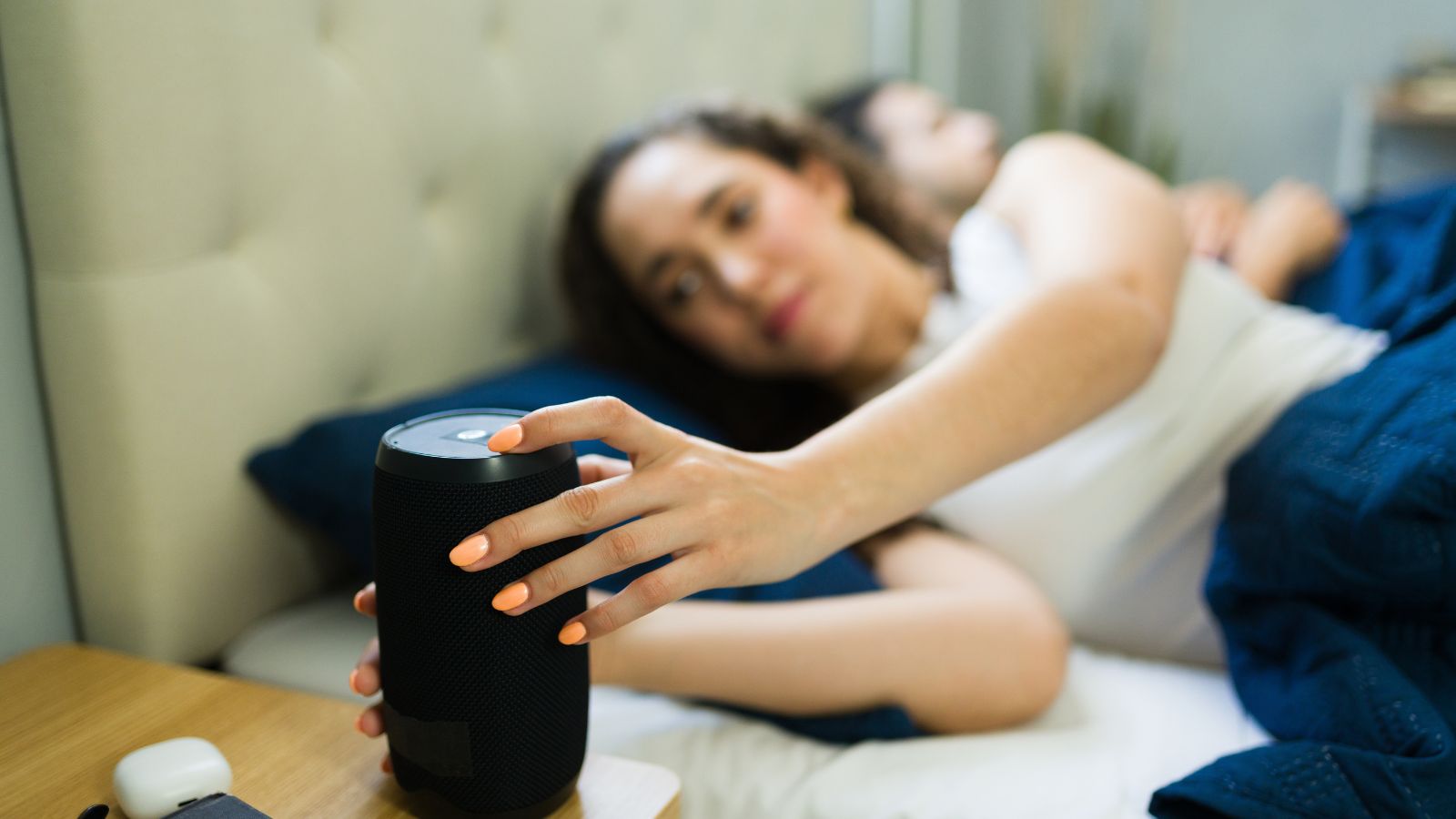
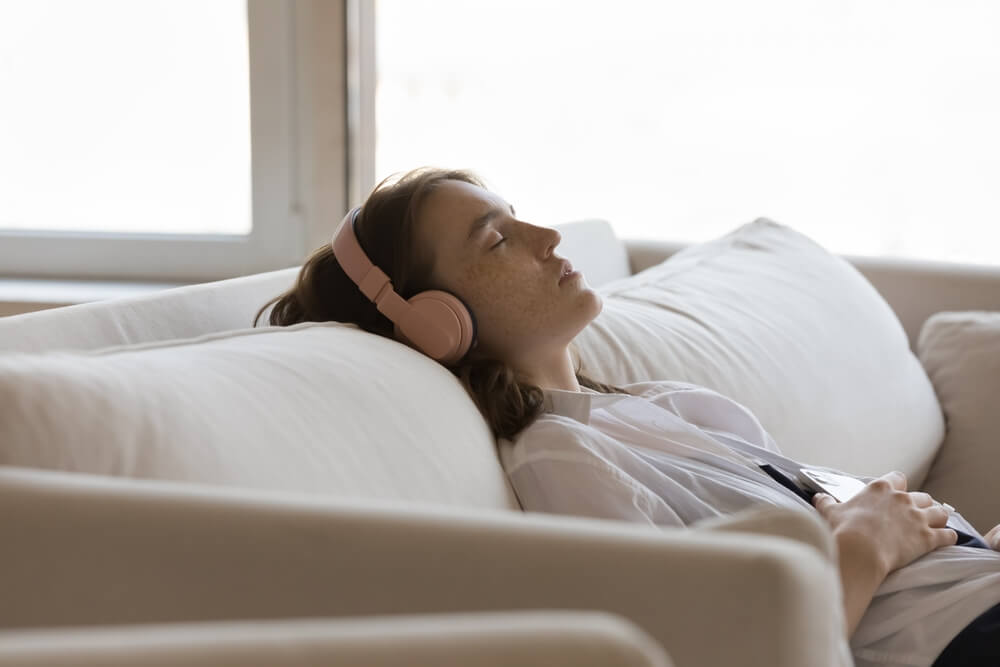
It works best when the sound plays quietly in the background through a speaker. It should mask other noises or make them less noticeable, without being distracting itself. Headphones, on the other hand, are less suitable for sleeping, as they can feel tight and play the sounds directly into your ears.
White noise can be switched on as soon as you go to bed. If you only want to use it to help you fall asleep, you can set a sleep timer. The sound will then stop automatically after a certain time and won’t continue playing all night.
It’s best to try out for yourself which background sound you find most pleasant. As well as white noise, there is also pink and brown noise, which sound softer or deeper respectively and are found more pleasant by some people.
Are there any disadvantages or risks associated with white noise?
White noise can also have drawbacks. Some people find the steady hum distracting or notice that it actually makes it harder for them to sleep. Whether white noise improves or impairs sleep can vary from person to person.
There is also a significant drawback: white noise can mask not only disturbing sounds but also those that you actually need to hear, such as an alarm or a child crying. Volume also plays a role. Prolonged exposure to high noise levels should be avoided, particularly if the white noise is played for many hours at a time.
It remains unclear what effects regular use over a long period might have. The long-term effects of white noise on the brain, the nervous system and hearing have not yet been sufficiently studied. Anyone who has difficulty falling asleep or staying asleep for several weeks, or who suffers significantly from the consequences during the day, should seek medical advice to investigate these symptoms.
Is white noise suitable as a sleep aid for babies and children?
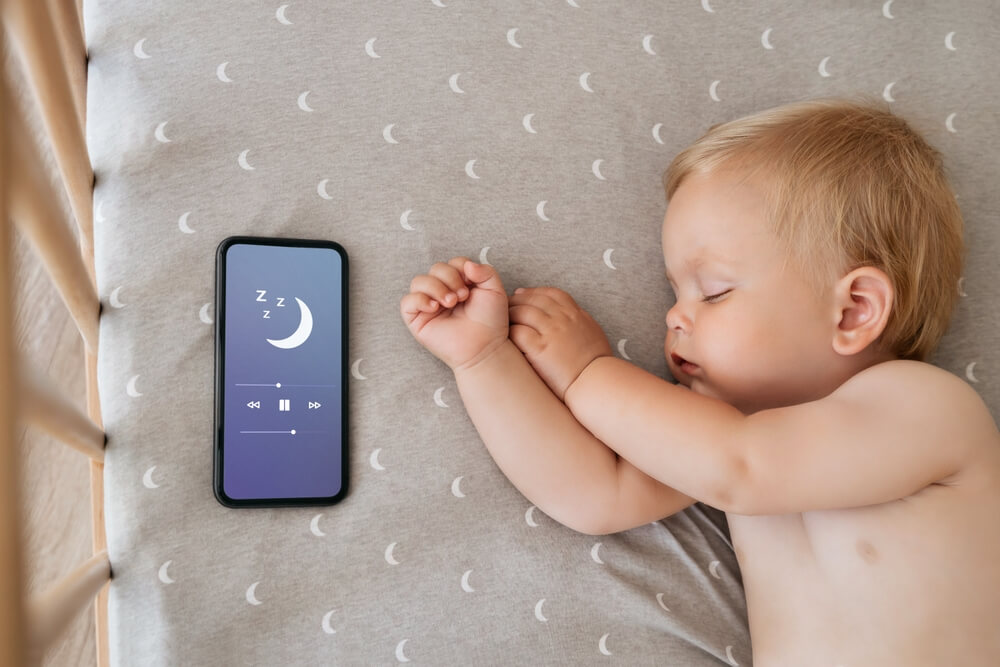
White noise is also used as a sleep aid for babies and young children. The steady background noise can, for example, mask voices, traffic or other household noises that disturb the child whilst they are trying to fall asleep. A few small studies suggest that white noise can indeed help babies fall asleep and calm down. Experts believe that white noise sounds are similar to those heard in the mother’s womb. However, the extent of the benefits and the effects of long-term use have not yet been sufficiently investigated.
Anyone wishing to try white noise can incorporate it into their bedtime routine. It is particularly important to be careful with the volume: the sound should be set as quietly as possible, and the sound source should not be placed directly next to the cot or the child’s head. Some white noise devices can reach sound levels at maximum volume that may be problematic for babies’ sensitive hearing.
The American Academy of Paediatrics therefore recommends placing white-noise devices as far away from the baby as possible, selecting the lowest reasonable volume and limiting the duration of use. The noise can, for example, be switched off automatically using a sleep timer.
Not every child reacts in the same way: some babies are soothed by steady sounds, whilst others sleep better without them. White noise is therefore not an essential part of a good sleep routine, but rather an option that parents can try if needed.
Where else is white noise used?
White noise is not only used for sleeping. It is used, for example, to mask conversations, traffic noise or other distracting background sounds. This is why similar ‘sound-masking’ systems are used in offices to reduce distractions.
White noise is also of interest in relation to concentration. A recent meta-analysis shows that white and pink noise may slightly improve performance on attention tasks in children and young adults with ADHD or significant attention problems. In people without ADHD, however, no benefit was observed; in fact, there was even a slight negative effect. White noise is therefore not a universal method for improving concentration.
Another application is in the treatment of tinnitus. In this context, steady background sounds can be used to make the ringing in the ears seem less noticeable. However, there is insufficient scientific evidence to confirm whether such sound therapy actually alleviates the symptoms. It is therefore more a way of managing the perceived noises than a treatment for the underlying cause.
When should sleep problems be investigated by a doctor?
Anyone who regularly sleeps poorly over several weeks and is consequently affected during the day should seek medical advice. Chronic insomnia is defined as difficulty falling asleep or staying asleep occurring at least three times a week for at least three months, and which also has an impact during the day.
However, if symptoms are severe, one should not wait three months. An earlier assessment is particularly advisable in cases of:
- severe tiredness or unintentional falling asleep during the day
- difficulty concentrating or a marked decline in performance
- loud, regular snoring accompanied by observed pauses in breathing
- nocturnal shortness of breath or a feeling of suffocation
- frequent waking with palpitations or other physical symptoms
- Sleep problems that are getting progressively worse or significantly affecting daily life
Even if sleep problems could be caused by pain, medication or psychological stress, it is advisable to seek medical advice.
FAQ
White noise should remain quiet in the background and not become a distracting noise in its own right. There is no universally applicable decibel level for adults. As a general rule, it should only be as loud as necessary to make distracting ambient noises less noticeable. High volume levels should be avoided, particularly during prolonged use.
There is no specific recommendation regarding the duration of use. If you use white noise primarily to help you fall asleep, you can set a sleep timer so that the sound stops automatically after a certain time. It is not usually necessary to leave it running all night. The long-term effects of regular use over many hours have not yet been sufficiently studied.
It is possible that white noise may, over time, become an integral part of one’s personal bedtime routine. However, there is insufficient scientific evidence to suggest that this could lead to an actual dependency or a problematic habituation. Anyone who wants to find out whether they still need the sound can gradually reduce the volume and the duration of use.
Yes, even the steady hum of a fan can mask distracting ambient noise and thus help you fall asleep. Strictly speaking, however, a fan does not produce true white noise, as the various frequencies are not distributed evenly. But if you find the sound soothing, you don’t even need to run a real fan: on Spotify, YouTube and other platforms, there are numerous playlists and recordings featuring fan noises.
There is no clear scientific consensus on whether white noise or pink noise is more effective for helping you sleep. Pink noise contains more pronounced low frequencies and therefore usually sounds softer than white noise. Many people find the sounds of rain, wind or the sound of the sea, for example, similarly soothing. Ultimately, it’s worth trying both options and choosing the background sound that helps you personally relax best.


https://www.sciencedirect.com/science/article/abs/pii/S1087079220301283?via%3Dihub, accessed: August 2026
https://www.fr.de/panorama/entwicklung-gestoert-neurologin-warnt-vor-beliebter-einschlafhilfe-bei-kindern-zr-93602827.html, accessed: August 2026
https://www.sciencedirect.com/science/article/abs/pii/S1389945725005441?via%3Dihub, accessed: August 2026
https://www.sciencedirect.com/science/article/abs/pii/S1087079220301283?, accessed: August 2026
https://pmc.ncbi.nlm.nih.gov/articles/PMC10200335/, accessed: August 2026
https://doi.org/10.1016/j.smrv.2020.101385, accessed: August 2026
https://doi.org/10.1016/j.sleep.2025.106869, accessed: August 2026
https://doi.org/10.5664/jcsm.9860, accessed: August 2026
https://doi.org/10.1542/peds.2023-063752, accessed: August 2026
https://doi.org/10.1016/j.sleep.2024.04.006, accessed: August 2026
https://doi.org/10.1016/j.jaac.2023.12.014, accessed: August 2026
https://doi.org/10.1002/14651858.CD006371.pub3, accessed: August 2026