Summary
An Overview of Creatine
What is creatine? Creatine is a substance produced naturally by the body that plays a key role, particularly in energy metabolism.
How does creatine work in the body? Creatine is a key component in the body’s energy supply to the muscles and helps the body to replenish energy more quickly during short bursts of exertion.
What are the benefits of creatine for sport? Creatine can boost performance during short bursts of intense exercise, support recovery between sessions and help maintain muscle strength.
What role can creatine play during perimenopause and the menopause? During perimenopause and the menopause, research into creatine focuses primarily on its links to muscle strength, muscle mass and the brain’s energy supply; it can play a supportive role, particularly when combined with strength training.
How is creatine taken? Creatine is usually taken daily in a dose of around 3 grams, regardless of when you train, ideally over a longer period of time.
Can creatine have side effects or pose risks? Creatine is considered well tolerated at the recommended dosage, but may cause temporary gastrointestinal discomfort or weight gain due to water retention in sensitive individuals.
Which foods contain creatine? Creatine occurs naturally mainly in animal-based foods such as red meat and fish, whilst plant-based foods contain hardly any significant amounts.
What is creatine?
Creatine is a carbon-nitrogen compound that the body can produce from the three amino acids glycine, arginine and methionine. A person needs around 2 grams of creatine per day.
Half of this – that is, the body’s own (endogenous) creatine – is produced by the adult’s own body. Synthesis takes place mainly in the liver and kidneys and, to a lesser extent, in the pancreas.
In addition, creatine is obtained through the diet. In this case, it is referred to as exogenous creatine. The most important natural sources are protein-rich animal foods, particularly red meat such as beef or pork, as well as fish and seafood. Dairy products also contain creatine, albeit only in comparatively small amounts.
Around 95 per cent of the total creatine stores are found in the skeletal muscles. The remainder is distributed amongst the heart, brain and other organs, amongst others.
How does creatine work in the body?
Creatine is a key component of the muscles’ energy supply. Whenever the body needs immediate energy during short, explosive or interval-style exertion, creatine plays a part in providing it.
In muscle cells, creatine is predominantly present in its stored form, phosphocreatine. The most important energy carrier in muscle cells is ATP (adenosine triphosphate). During muscular activity, ATP is rapidly consumed and converted into ADP (adenosine diphosphate). However, the body’s own ATP reserves are very limited and last for only a few seconds during maximum exertion.
This is where creatine plays a key role. In the form of phosphocreatine, it transfers its phosphate group to ADP, thereby regenerating ATP. This rapidly replenishes the muscle cell’s energy stores, enabling performance at high intensity to be sustained for longer.
This mechanism explains why creatine has a measurable effect, particularly during short-term, high-intensity exercise. In contrast, its influence is minimal during longer, steady-state endurance exercise, as other energy systems – such as fat and carbohydrate metabolism – dominate in these situations.
In summary, creatine helps the body to achieve maximum performance in the short term. It accelerates energy supply to the muscles, delays early fatigue during intense exercise and thus improves performance in clearly defined situations.
What are the benefits of creatine in sport?
Creatine is one of the most thoroughly researched sports supplements. There are well-founded scientific recommendations, particularly for athletes who regularly engage in high-intensity exercise.
The best-documented positive effects include:
1. Improved performance during short, high-intensity exercise
Numerous studies show that creatine can improve athletic performance during short, intense exercises. These include, for example, sprints, heavy strength training and repeated high-intensity intervals.
In these situations, the muscles require large amounts of energy within seconds. Creatine supports precisely this process by enabling the rapid regeneration of ATP. This is particularly beneficial for sports where explosive power, speed or repeated maximum efforts are crucial.
2. Increased strength and muscle growth
An indirect but important benefit of creatine becomes apparent during training itself. If the improved energy supply allows for a few more repetitions, slightly heavier weights or a consistently high intensity, this has a long-term impact on training results.
Over weeks and months, this can lead to increased strength and more efficient muscle growth. Not because creatine ‘builds’ muscle, but because it enables you to train more effectively. Due to increased water retention within the muscle cells, the muscles may also appear more voluminous and firmer.
3. Faster muscle recovery
Beyond its immediate effects on performance, creatine can also support muscle recovery. Some studies suggest that creatine supplementation can reduce muscle damage and inflammatory responses following intense exercise. This can shorten the recovery time between training sessions.

Creatine: Effects on the brain and mental health
Creatine is not only relevant for the muscles, but also plays a role in the brain’s energy metabolism. Although the brain accounts for only around two per cent of body weight, it consumes a significant proportion of the energy available each day. Like muscle cells, nerve cells also require ATP as an energy source – and thus, indirectly, creatine.
The scientific evidence regarding the effects of creatine on the brain and mental health is less conclusive than in the field of sport, but it does provide interesting insights. Studies show that creatine can support specific cognitive functions, such as short-term memory or attention, in situations involving high mental strain, such as sleep deprivation or stress. These effects are particularly evident when the brain is under significant energy demand.
Creatine is also being investigated in relation to mental health. Some studies suggest that creatine – usually as a supplement to existing therapies – could alleviate depressive symptoms. However, the evidence is still very limited and does not currently allow for any general recommendations.
In summary, creatine is regarded as an interesting avenue of research for the brain and mental health. The findings to date are promising, but not yet sufficient to draw clear conclusions for everyday life.
Perimenopause and menopause: what role can creatine play?
With the onset of perimenopause and, at the latest, during the menopause, hormonal balance, muscle metabolism and body composition undergo changes. Falling oestrogen levels contribute, amongst other things, to the loss of muscle mass, a decrease in muscle strength and slower recovery after exercise.
Against this backdrop, creatine is increasingly becoming the focus of research. Among other things, the following potential effects of creatine in relation to perimenopause and menopause are being investigated:
- Effect on muscle strength and muscle mass: Studies show that creatine, when combined with strength training, can help maintain and build lean muscle mass. This can be particularly relevant during the peri- and menopausal periods, as strength training is considered one of the most important measures for counteracting age- and hormone-related muscle loss. Studies show that creatine can improve performance and support muscle tone over the long term in both trained and untrained women.
- Support for bone health: With increasing age – particularly after the menopause – the decline in oestrogen levels often leads to a loss of muscle and bone mass. Creatine may help to partially counteract these processes. A direct effect of creatine on bone density has not yet been conclusively proven. Research findings from 2021 suggest that creatine – particularly when combined with strength training – can support bone health.
- Brain health and mental performance: Creatine is repeatedly linked to positive effects on cognition, mood and mental performance. There are not yet sufficient studies on this, but the findings to date are promising. Creatine is currently being investigated as a potential supportive factor, particularly for typical symptoms of perimenopause and menopause such as concentration problems (‘brain fog’) or lack of sleep.
Creatine is not a substitute for hormonal or medical treatment, but it can play a complementary role as part of a holistic approach.

Taking creatine: what works best?
For creatine to be effective, one thing is crucial above all else: regularity. Creatine does not have an immediate effect, but works by building up creatine and phosphocreatine stores in the muscles. The aim is to gradually increase these stores and maintain them at a stable level over the long term.
What is the correct dosage?
Studies have shown that a daily intake of 3 grams of creatine, up to a maximum of 5 grams, is effective. This dosage is considered sufficient to reliably saturate muscle stores and is generally well tolerated. Higher amounts usually offer no additional benefit.
Loading phase: necessary or not?
Some recommendations suggest a so-called loading phase, during which very high amounts of creatine (e.g. 20 grams per day for 5 days) are taken over several days. The aim is to replenish stores more quickly.
From a scientific point of view, such a phase is not necessary and is generally no longer recommended. Even with a moderate daily intake, creatine stores can be reliably increased, albeit slightly more slowly.
When should creatine be taken?
The exact time of day does not matter. Creatine can, in principle, be taken at any time. What matters is the daily intake, not the timing.
Some studies suggest that taking it around the time of training may be slightly beneficial, but the difference is considered to be minimal.
What type of creatine should be taken?
Not all creatine is the same. Various forms are available on the market, such as those combined with other acids, buffered products or supplements that promise particularly good absorption.
From a scientific point of view, however, creatine monohydrate is the most relevant form. This form has been most extensively studied and has served as the reference in the majority of studies. Anyone who values well-documented efficacy and a reliable body of evidence is therefore on the safe side with tested creatine monohydrate.
Can creatine have side effects and risks?
Creatine is considered to be well-researched and generally well-tolerated in healthy adults. Nevertheless, as with many dietary supplements, side effects can occur. These mainly affect the digestive tract, body weight and, in isolated cases, the muscles.
Possible side effects include:
- Gastrointestinal complaints such as flatulence, bloating, diarrhoea or nausea. These symptoms occur mainly at higher doses.
- Slight weight gain: A common effect at the start is a slight weight gain, particularly when first starting to take the supplement. This is not caused by an increase in body fat, but by increased water retention within the muscle cells. As a rule, this can result in a weight gain of up to 2 kg.
- Kidney disorders: Creatine is particularly often associated with potential risks to kidney function. According to current research, there is no conclusive evidence that creatine damages the kidneys in healthy people when taken at the recommended dosage. However, in cases of existing kidney disease, abnormal laboratory test results or regular use of kidney-specific medication, creatine should only be taken after consulting a doctor.
- Muscle cramps: Muscle cramps are also very rarely reported as a side effect.
What happens in the event of a creatine deficiency?
A severe creatine deficiency is rare, but can have functional consequences. If creatine stores are low, the body has less readily available energy during intense physical exertion.
This can manifest as reduced physical performance, for example through earlier fatigue, declining muscle strength or a lower tolerance for exertion. Recovery following physical exertion may also be slowed down.
Furthermore, there is evidence to suggest that low creatine levels may be associated with increased susceptibility to stress. Those affected may be less resilient to physical or mental demands, particularly during periods of high stress.
Which foods contain creatine?
Creatine is found in significant quantities primarily in animal-based foods. Particularly rich sources include red meat and oily fish. Plant-based foods do not contain creatine, which is why people following a vegetarian or vegan diet tend to have lower creatine stores on average.
It should also be noted that some of the creatine may be lost during food preparation. As creatine is heat-sensitive and water-soluble, its content decreases, particularly during cooking and frying.
| Foods | Creatine content (mg per 100 g) | Category |
|---|---|---|
| Beef | approx. 450 mg | very high |
| Pork | approx. 500 mg | very high |
| Game (roe deer, red deer, wild boar) | approx. 1.5 g | extremely high |
| Herring | approx. 650–1,000 mg | extremely high |
| Salmon | approx. 450 mg | very high |
| Tuna | approx. 400 mg | high |
| Cod | approx. 300 mg | high |
| Plaice | approx. 200 mg | high |
| Chicken | approx. 350–400 mg | high |
| Milk (cow’s milk) | approx. 10 mg | very low |
Who should take creatine?
For a long time, creatine was primarily associated with strength training and fitness. However, studies now show that its potential benefits may extend beyond the traditional sporting context. Its effects in sport are particularly well documented, but non-athletes can also benefit.
This includes, in particular, vegetarians and vegans, who consume less creatine through their diet, women going through perimenopause and the menopause, and older people, whose muscle strength and physical performance decline with age.
Furthermore, creatine is also being investigated in relation to mental resilience and depressive symptoms. However, these effects have not yet been conclusively proven and should therefore be interpreted with caution.
What you should bear in mind when taking creatine supplements
Creatine is available in numerous forms, such as powder, tablets or capsules. You should bear the following points in mind when taking it.
- Ensure you take the correct dosage: according to the German Nutrition Society, a daily intake of around three grams is considered safe.
- Regular intake is important: creatine does not work in the short term, but rather by building up stores in the muscles. It should therefore be taken daily to ensure a consistent effect.
- Ensure you drink enough fluids: As creatine causes more water to be stored in muscle cells, it is advisable to drink plenty of fluids. As a guide, aim for 100 to 150 millilitres of water per gram of creatine. With a daily dose of three grams, this corresponds to around half a litre of additional fluid.
- Choose the right form of creatine: Creatine is available in various chemical forms. To date, creatine monohydrate has been the most thoroughly researched.
Did you know?
Creatine occurs naturally in the body.
The body produces creatine itself every day and stores most of it in the muscles. Dietary supplements therefore do not serve to supply an external substance, but merely increase existing stores.
People who do not eat meat often experience a stronger response.
Vegetarians and vegans have, on average, lower creatine stores and frequently benefit more from supplementation in studies.
More weight does not mean more fat.
The initial weight gain associated with creatine is usually due to water stored within the muscle cells – not to additional body fat.
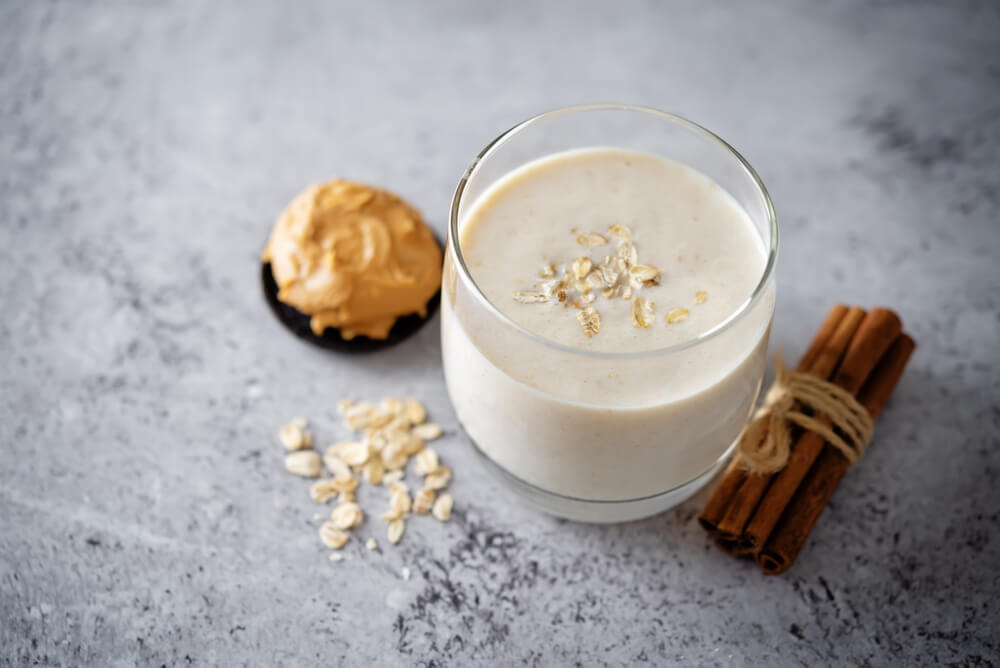
Recipe: Peanut butter and banana shake with creatine
Ingredients for 1 shake
- 1 ripe banana
- 1 tbsp peanut butter
- 1 tsp unsweetened cocoa
- 250 ml oat milk, rice milk or almond milk
- 2 Medjool dates or 1 tbsp maple syrup
- 3 g creatine
- 1 pinch of cinnamon
Method
- Peel the banana and cut it into rough pieces.
- Place all the ingredients in a blender.
- Blend until smooth and creamy.
- Dilute with a little more plant-based milk to taste.
Tip
For a particularly chilled version, you can blend in a few ice cubes. If you’d like to make the shake higher in protein, you can also mix in 1 tbsp of protein powder.
FAQ
There is generally no reason not to take creatine and protein together. Both fulfil different functions in the body and do not interfere with one another. Creatine supports the rapid supply of energy to the muscles, whilst protein is primarily important for the maintenance and growth of muscle tissue.
In practice, combining the two can be beneficial. If creatine is taken alongside a protein-rich meal or a protein shake, it can indirectly support training performance: having more energy available during training, combined with sufficient building blocks for subsequent recovery. However, there is no conclusive evidence of a definite advantage over taking them separately.
The first effects usually become apparent after one to three weeks, once creatine stores in the muscles have increased significantly. The exact timeframe varies from person to person.
At the start, body weight may increase slightly. This is usually due to water being stored within the muscle cells, rather than an increase in body fat.
No. High initial doses are not necessary. Even with a consistent, moderate daily intake, the stores can be reliably replenished.
The exact timing is of secondary importance. What matters is consistency. Creatine does not have an immediate effect, but works by building up stores over the long term.
There is no reliable evidence to support this in healthy adults. If you have an existing kidney condition, you should consult your doctor before taking this.
Yes. As creatine is found almost exclusively in animal-based foods, the body’s stores are often lower in these groups.
There is insufficient safety data available for use during pregnancy and whilst breastfeeding. It is therefore not recommended.


https://sportaerztezeitung.com/rubriken/ernaehrung/1511/kreatin/, accessed: December 2025
https://www.uclahealth.org/news/article/why-everyones-talking-about-creatine, accessed: December 2025
https://pmc.ncbi.nlm.nih.gov/articles/PMC4915971/,Zugriffed: December 2025
https://www.health.harvard.edu/exercise-and-fitness/what-is-creatine-potential-benefits-and-risks-of-this-popular-supplement, accessed: December 2025
https://pmc.ncbi.nlm.nih.gov/articles/PMC8228369/, accessed: December 2025
https://pmc.ncbi.nlm.nih.gov/articles/PMC7998865/, accessed: December 2025
https://www.essendonsportsmedicine.com.au/about/blog/benefits-of-creatine-for-sports-performance, accessed: December 2025
https://my.clevelandclinic.org/health/treatments/17674-creatine, accessed: December 2025
https://www.klartext-nahrungsergaenzung.de/faq/lebensmittel/kreatin-zur-gedaechtnisverbesserung-97648, accessed: December 2025
https://www.wolfs-apotheke.de/gesundheitsbibliothek/index/kreatin/, accessed: December 2025
https://www.sportslab.at/blogs/news/lebensmittel-mit-hohem-kreatingehalt, accessed: December 2025
https://sportaerztezeitung.com/sports-research/kreatin-als-behandlung-von-depressionen/, accessed: December 2025
https://www.dgm.org/sites/default/files/2022-11/Kreatin_eine%20kurze%20%C3%9Cbersicht_%2011_2022.pdf, accessed: December 2025