Summary
Factbox – Measles
Measles: a viral disease (highly contagious, notifiable); considered a typical childhood infectious disease, but can also affect adolescents and adults
Causative agent: measles virus
Transmission: droplet infection, direct contact with infectious nasal/throat secretions
Incubation period: On average, eight to ten days
Course of the disease: Prodromal stage, main stage (exanthem stage)
Symptoms: Fever, runny nose, sore throat, dry cough, fatigue, digestive problems, conjunctivitis with sensitivity to light, Koplik’s spots, measles rash, etc.
Possible complications/consequential conditions: Bronchitis, pneumonia, middle ear infection, diarrhoeal diseases, encephalitis, etc., subacute sclerosing panencephalitis (SSPE) as a possible long-term complication (after approximately six to eight years)
Diagnosis: Medical history, physical examination, blood tests/laboratory tests
Treatment: Physical rest, bed rest, high fluid intake, etc.
Prevention:
Vaccination
What is measles?
Measles is a highly contagious viral disease. Although it is often regarded as a typical childhood illness, teenagers and adults can also become infected with the measles virus. In most cases, the illness is mild, but the risk of a severe course of the disease is higher, particularly in young children and adults. In this article, you will find important information on transmission, symptoms, possible complications and the measles vaccination.
How is measles transmitted?
Measles is caused by the measles virus. The virus is transmitted from person to person in two ways:
- Droplet transmission: This occurs when infected people expel droplets of secretions whilst speaking, coughing or sneezing, which are then inhaled by others.
- Direct contact: The measles virus can also be transmitted through direct contact with infectious secretions from the throat or nose, for example by sharing crockery or cutlery with infected people.
Measles is extremely contagious and even brief contact can lead to infection. The incubation period – that is, the time from infection to the onset of the first symptoms – is usually 8 to 10 days. The risk of infection is highest shortly before and after the onset of the typical rash (measles exanthema). A person can only contract measles once in their lifetime. Upon infection, the immune system produces specific antibodies against the measles virus, which become active upon renewed contact and fight off the pathogen. Anyone who has had the infection once is therefore protected against reinfection for life.
What is the measles situation in Austria?
As of 1 January 2024, 192 confirmed cases of measles had been recorded in Austria via the epidemiological reporting system. It is likely that the number of cases will continue to rise.
Symptoms of measles: what are the signs?
Measles progresses through two stages: the prodromal stage and the main stage. Both stages are accompanied by bouts of fever. Prodromal stage: The prodromal stage lasts around 3–4 days. Possible early signs include:
- Mild fever
- Runny nose
- Sore throat
- Dry cough
- Fatigue
- Digestive problems (constipation or diarrhoea)
- Conjunctivitis and sensitivity to light
- Koplik’s spots: small red spots with a pale centre on the inner lining of the cheeks
At this stage, the fever rises and then falls again, before rising once more in the main stage. The main stage (exanthematous stage) is characterised by:
- Rising fever
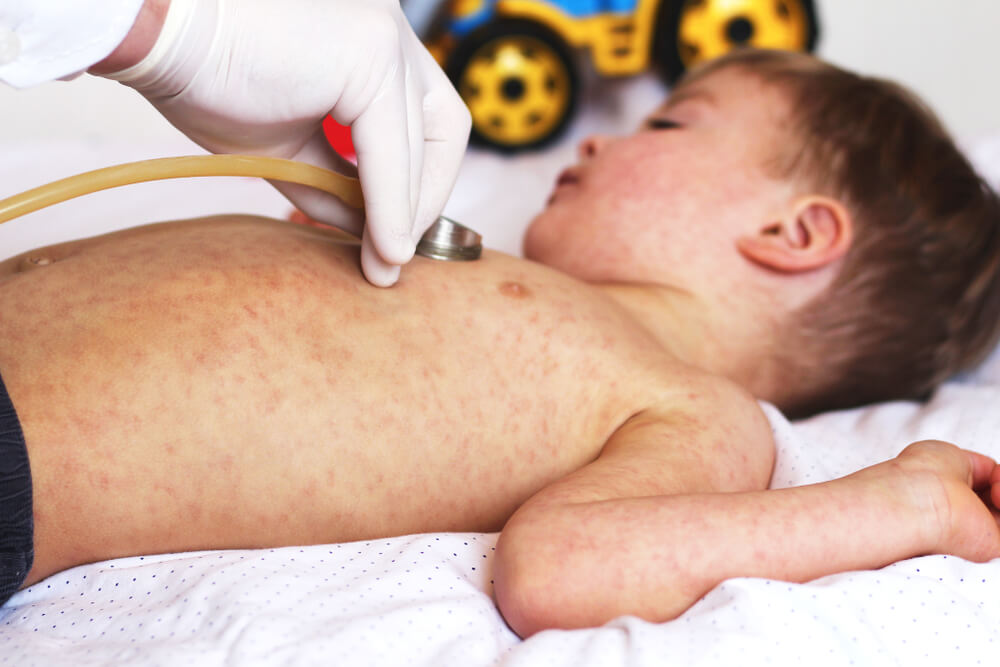
- Development of the typical measles rash: irregular red spots, a few millimetres in size, which may merge and spread first behind the ears and then across the face, upper body and limbs (the palms of the hands and soles of the feet are usually spared).
The rash disappears after about five to six days, with the fading of the measles spots often accompanied by slight flaking of the skin. Once the rash has completely disappeared, the person is no longer considered infectious. If no complications arise, the recovery period usually lasts 14 days. Important: If measles is suspected, the doctor must be informed in advance by telephone.
What are the possible complications or long-term effects of measles?
Measles is not a harmless childhood illness. In most cases, measles clears up without any problems. However, the disease can cause complications and have serious consequences. In developed countries, the complication rate is around 20 per cent. Young children and adults are particularly at risk. Measles weakens the immune system, making the body more susceptible to further infections. Possible complications include:
- respiratory conditions such as bronchitis and pneumonia
- Middle ear infection
- Diarrhoeal diseases
- Encephalitis, a rare inflammation of the brain that can have serious consequences
- Subacute sclerosing panencephalitis (SSPE), a very rare but fatal long-term complication that can occur years after the initial infection. Subacute sclerosing panencephalitis (SSPE) occurs in approximately 1 to 5 out of every 10,000 cases of measles, with infants and newborns being particularly at high risk.
Contracting measles during pregnancy can lead to premature birth or miscarriage and increase the risk of serious complications such as pneumonia or encephalitis.
How is measles treated?
Treatment for measles is symptomatic, as there is no specific treatment for the measles virus. Key measures include:
- rest
- bed rest
- plenty of fluids
- easily digestible food
- a well-ventilated room, darkened if necessary
If the child has a fever or a cough, fever-reducing and cough-suppressing medicines may be used following consultation with a doctor. Depending on the severity of the illness, hospitalisation may also be necessary. Any bacterial infections, such as middle ear infections, can be treated with antibiotics.
How can measles be prevented?
The only effective protection against infection is vaccination. In Austria, a free MMR (measles, mumps, rubella) vaccination is available for all age groups. The vaccination (combined live vaccine) is administered during childhood, but only provides lifelong immunity if both doses of the vaccine are given. Full immunisation requires two doses, starting from the ninth month of life. It is recommended that vaccination status be checked and, if necessary, catch-up doses administered upon starting school or at the age of 12. Catch-up vaccination is also possible for adolescents and adults, particularly in cases of lack of immunity or incomplete vaccination records. Vaccination is particularly important for people in contact with children or working in the healthcare sector, as well as for women of childbearing age.
Which doctor should I contact?
At the first signs of symptoms or if you suspect you have the disease, you must inform your doctor by telephone in advance. You can contact the following doctors:
FAQ
It is not only children but also adults who can contract measles. The disease is caused by a virus and is particularly dangerous for people who have not been fully vaccinated. Adults who did not receive all the recommended doses of the vaccine as children are at an increased risk of contracting measles.
A childhood illness such as measles can weaken the body, for example through a prolonged, high fever. Serious consequences, such as encephalitis with the potential for permanent impairment, are often underestimated. Compared with the infection itself, the measles vaccine carries a significantly lower risk whilst offering strong protection.
The incubation period for measles is typically around 7 to (rarely) 21 days. It is usually 7 to 14 days.
Because the immune system is weakened, people are more susceptible to other illnesses following a measles infection. These include, amongst others, middle ear infection, bronchitis and laryngitis. Serious complications can also arise, such as meningitis (encephalitis) or subacute sclerosing panencephalitis (SSPE). If pregnant women contract measles, this can lead to premature birth or miscarriage.
Measles progresses in two stages. Initially, cold-like symptoms appear, such as a fever, a cough, a runny nose or a sore throat. The fever initially subsides, then a bright red rash develops and the fever rises again.
No, if a mild, measles-like rash appears, it is not contagious.
The risk of serious complications from measles is particularly high in children under the age of five and in adults. Patients with a weakened immune system may experience particularly severe cases. Pregnant women are also at increased risk of developing complications.


Austrian Immunisation Schedule 2023/2024, Federal Ministry of Labour, Social Affairs, Health and Consumer Protection https://www.sozialministerium.at/Themen/Gesundheit/Impfen/Impfplan-%C3%96sterreich.html, accessed 8 February 2024
Heininger U.; Measles Vaccination in Practice – Ten Important Questions and Answers on the MMR Vaccine, ARS Medici 1+2/2018, Rosenfluh Publikationen AG
Flick H. et al.; Pertussis and Measles on the Rise, Universum Innere Medizin 10/2015, MedMedia Verlag und Mediaservice GmbH
Wiedermann-Schmidt U. et al.; Measles, Pertussis, Pneumococci, HPV: Using patient consultations to provide information, Universum Innere Medizin 01/2014, MedMedia Verlag und Mediaservice GmbH
Measles, RKI Guide, Robert Koch Institute, URL: https://www.rki.de/DE/Content/Infekt/EpidBull/Merkblaetter/Ratgeber_Masern.html, last accessed: 08.02.2024
WHO: Measles, global situation, https://www.who.int/news-room/fact-sheets/detail/measles, accessed: 8 February 2024
Measles: current situation in Austria: https://www.ages.at/mensch/krankheit/krankheitserreger-von-a-bis-z/masern, 8 February 2024
Austrian Ministry of Social Affairs, https://www.sozialministerium.at/Themen/Gesundheit/Uebertragbare-Krankheiten/Infektionskrankheiten-A-Z/Masern.html. 8 February 2024