Summary
MMR vaccination
Definition: an active triple combination vaccine containing inactivated or attenuated pathogens which cannot themselves cause serious illness, but which stimulate the immune system to produce antibodies against measles, mumps and rubella.
Dosage: two doses
Recommended for: all children and unvaccinated adults
Contraindications: pregnant women, people with a weakened immune system, people with a fever of over 38 degrees
Cost: none
What are measles, mumps and rubella?
Measles, mumps and rubella are highly contagious viral diseases that are found all over the world. They are spread through droplet transmission, mainly when people speak, cough or sneeze. All three diseases can lead to serious complications or long-term health problems. Vaccination provides reliable protection against these diseases.
Measles – transmission, symptoms and complications
The highly contagious measles virus is transmitted through direct contact or via respiratory droplets. After an incubation period of around 8 to 10 days, the following symptoms may occur in measles:
- high fever
- respiratory illnesses
- conjunctivitis
- a runny nose
- sore throat
- dry cough
- Fatigue
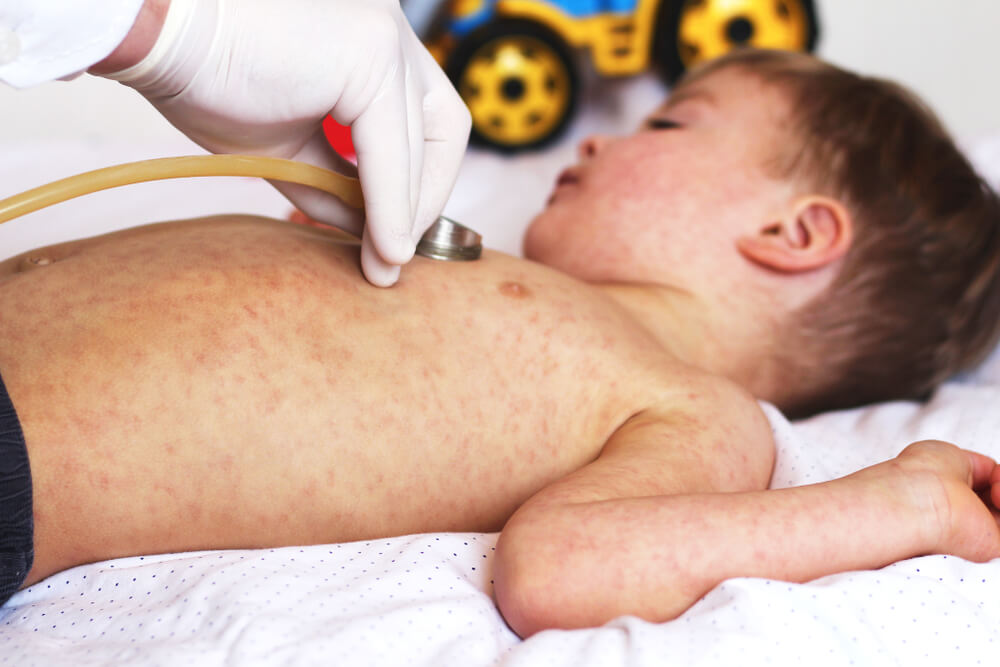
- a typical dark red, patchy rash.
In most cases, measles clears up without any problems. However, the illness can cause complications and have serious consequences.
Possible complications include:
- respiratory conditions such as bronchitis
- Diarrhoea
- Middle ear infection
- Encephalitis (inflammation of the brain)
- Subacute sclerosing panencephalitis (SSPE), a very rare but fatal late complication that can occur years after the initial infection.
Infection during pregnancy also carries an increased risk of premature birth or miscarriage, as well as serious complications such as pneumonia or encephalitis.
Mumps – transmission, symptoms and complications
Mumps is a disease caused by the mumps virus, which spreads via droplet transmission. This virus is highly contagious, with an incubation period of 12 to 14 days.
Symptoms that may occur with mumps:
- Swelling that is tender to the touch in front of and below the ear, and occasionally in the salivary glands, affecting either one side or both
- Fever
- Headache
- General fatigue
- Loss of appetite
- Difficulty chewing
- Earache
Possible complications of mumps include:
- Encephalitis
- Meningitis
- Inflammation of the pancreas (pancreatitis)
- Inflammation of the testicles or ovaries
- Inner ear hearing loss
Rubella – transmission, symptoms and complications
Rubella is a highly contagious viral disease caused by the rubella virus, which spreads via droplet transmission. The incubation period for rubella is between 14 and 21 days.
Symptoms of rubella include:
- A fine, red rash, which typically starts on the face and behind the ears.
- Swollen lymph nodes in the neck
- Joint pain
- Fever
- Headache
- Fatigue
Possible complications of rubella include:
- Inflammation of the joints, which can cause pain.
- Bronchitis
- Middle ear infection
- Encephalitis
- Inflammatory conditions of the heart muscle and pericarditis, which can affect the heart.
- In pregnant women, particularly up to the 17th week of pregnancy, rubella can lead to miscarriage, premature birth or severe foetal abnormalities, including deafness, heart defects and cataracts.
What is the MMR vaccine and how does it work?
The MMR vaccine is an active vaccine. This means that it involves administering killed or attenuated pathogens – which cannot themselves cause serious illness – thereby stimulating the body’s immune system to produce antibodies against the pathogens that cause measles, mumps and rubella.
The live vaccine therefore contains attenuated measles, mumps and rubella viruses, as well as preservatives and an adjuvant, which can enhance the vaccine’s effectiveness. The vaccine is administered in two doses to ensure full protection.
What should you bear in mind regarding the MMR vaccination for babies?
Experts recommend two doses to develop full protection. The first dose should be given from the age of 9 months, with the second dose administered three months later. If the first dose is given after the child has turned one year old, the second dose should follow as soon as possible, but with a minimum interval of four weeks from the first dose.
What should be borne in mind regarding the MMR vaccination for adults?
Adults should receive two MMR vaccinations, spaced at least four weeks apart. This is particularly important for women of childbearing age, as measles can lead to serious complications for both mother and child during pregnancy. Similarly, rubella can cause birth defects in the unborn child. However, the MMR vaccine should not be administered during pregnancy itself, as it is a live vaccine.
When should the vaccine not be administered?
The MMR vaccine must not be given to pregnant women, people with a weakened immune system, or anyone with a fever of over 38 degrees. People who are prone to allergic reactions following vaccinations should seek medical advice before being vaccinated.
What are the possible side effects of the vaccine?
The MMR vaccine can cause common vaccine reactions, including mild and temporary redness and swelling at the injection site, headaches and a fever that may last for one to two days. A rash may also occur and, in very rare cases, joint pain. These reactions are signs that the body is responding to the vaccine. Serious side effects, such as febrile convulsions, are very rare.
How much does the vaccination cost?
The MMR vaccination is included in Austria’s free vaccination programme and is also available free of charge to adults.
Where can you get vaccinated?
The MMR vaccination is available free of charge at GPs’ surgeries participating in the vaccination programme and at all public vaccination centres. For more information, visit: www.gesundheit.gv.at/service/beratungsstellen/impfen
Where can I find further information on the MMR vaccine?
You can find further detailed information on the MMR vaccination, for example, in the Austrian Immunisation Schedule: https://www.sozialministerium.at/Themen/Gesundheit/Impfen/Impfplan-Österreich.html


Gesenhues S and A: A Practical Guide to General Practice. 9th edition, Urban & Fischer 2020.
Federal Ministry of Social Affairs, Health, Care and Consumer Protection: Austrian Immunisation Schedule 2023 (Version 1.1 of 23 December 2022)
https://www.sozialministerium.at/Themen/Gesundheit/Impfen/Impfplan-Österreich.html, accessed January 2024
https://www.gesundheit.gv.at/leben/gesundheitsvorsorge/impfungen/ueberblick/mmr-impfung.html, accessed January 2024
https://www.rki.de/SharedDocs/FAQs/DE/Impfen/MMR/FAQ_Uebersicht_MSG.html, accessed January 2024