Summary
Mouth Taping
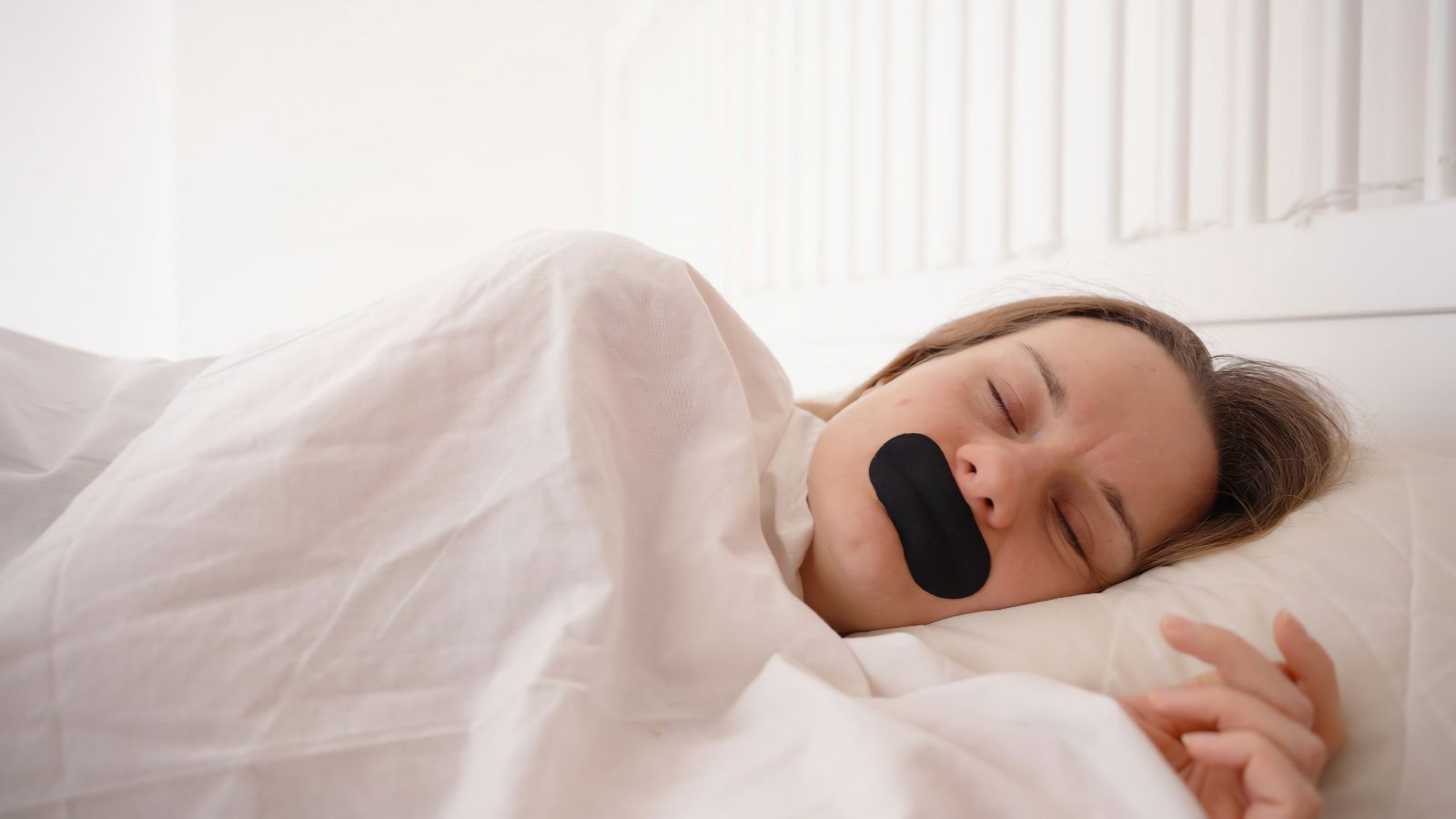
What is mouth taping? Mouth taping involves sealing the lips with a special tape or plaster before going to bed. This is intended to prevent mouth breathing and encourage nasal breathing.
What are the claimed benefits of mouth taping? Among other things, mouth taping is said to reduce snoring and dry mouth, and to improve sleep quality. However, there is as yet no convincing scientific evidence for many of these claimed benefits.
Does mouth taping help with snoring and sleep apnoea? Small studies suggest that mouth taping might reduce snoring in some people. However, the current body of research is insufficient to recommend mouth taping as a treatment.
What are the risks of mouth taping? Possible side effects include skin irritation, discomfort and difficulty breathing. Mouth taping should be avoided, particularly if nasal breathing is blocked or otherwise restricted.
What is mouth taping and how does it work?
Mouth taping involves sealing the mouth with a plaster or special adhesive tape before going to bed. Often, a narrow strip is stuck vertically across the lips, but there are also specially shaped mouth plasters that cover a larger part of the lips.
The principle behind it is simple: if the mouth cannot open, or can only open with difficulty, whilst sleeping, this automatically encourages more breathing through the nose. The aim is to reduce mouth breathing at night and promote nasal breathing. Mouth taping has become particularly well-known through TikTok and other social media platforms. There are now numerous specially designed mouth tapes available.

Why is nasal breathing better than mouth breathing?
Our nose isn’t just for smelling. It filters, warms and moistens the air we breathe in before it reaches the lower airways. Nose hairs and the mucous membrane trap dust, pollen and some pathogens. When breathing through the mouth, a significant part of this natural filtering function is lost.
People who regularly sleep with their mouth open are also more likely to wake up with a dry mouth or throat. In the long term, the lack of saliva can also affect oral health, as saliva protects the teeth and mucous membranes, amongst other things.
Another benefit of nasal breathing relates to nitric oxide (NO). This signalling molecule is produced, amongst other places, in the paranasal sinuses and enters the lungs when air is inhaled through the nose. There, nitric oxide helps to dilate the blood vessels and regulate blood flow to the lungs. This supports the exchange of oxygen between the lungs and the blood. When breathing through the mouth, significantly less nitric oxide from the nose enters the inhaled air.
However, the benefits of nasal breathing do not automatically justify the use of mouth taping. Anyone who frequently breathes through their mouth at night should first establish why nasal breathing is insufficient. The aim should therefore not simply be to prevent mouth breathing, but to enable nasal breathing to be as unobstructed as possible.
Health benefits of mouth taping: fact-checking
Nasal breathing has a number of advantages over mouth breathing. But does that automatically mean that mouth taping is healthy too? This is precisely where the evidence from studies is far less clear-cut. On social media, taping the mouth shut at night is credited with a whole range of positive effects: it is said to reduce snoring, improve sleep quality, prevent a dry mouth and, in some cases, even help with conditions such as sleep apnoea.
Many of these claims sound plausible at first glance. The crucial question, however, is: which of these have actually been investigated and scientifically proven in relation to mouth taping? We’ll take a closer look at the key claims one by one.
Does mouth taping help with snoring?
Mouth taping may reduce snoring in some people, but this effect has not yet been sufficiently proven scientifically. The idea behind it is understandable: keeping the mouth closed encourages nasal breathing. This can reduce the snoring noises caused by breathing through an open mouth.
Indeed, some small studies do show such an effect. In a systematic review from 2025, the so-called snoring index was examined in three of the included studies. In all three studies, it decreased significantly when the mouth was closed or kept closed. However, the studies were small and, overall, of limited quality. It is therefore not possible to conclude with certainty that mouth taping generally helps to prevent snoring.
Furthermore, snoring can have various causes. If, for example, there is restricted nasal breathing, mouth taping does not address the actual cause. It is also particularly important that regular, loud snoring accompanied by breathing pauses, marked daytime tiredness or other signs of sleep apnoea should not simply be treated with a plaster, but that the patient should consult an ENT specialist.
Mouth taping is therefore not a generally recommended treatment for snoring. Anyone who snores regularly should instead find out why – particularly if other symptoms are present.

Does mouth taping help with sleep apnoea?
Sleep apnoea involves repeated pauses in breathing or significantly reduced breathing during sleep. This is precisely where the idea sounds tempting: if mouth taping promotes nasal breathing, might it not also improve breathing at night?
In fact, there is preliminary evidence of a potential benefit in cases of mild obstructive sleep apnoea. In a small study involving 20 participants, the so-called apnoea-hypopnoea index (AHI) – that is, the number of breathing pauses and periods of reduced breathing per hour – fell from an average of 8.3 to 4.7 as a result of mouth taping. Snoring also decreased significantly. However, the conclusiveness of such a small study is limited.
Another study involving 54 people with obstructive sleep apnoea shows that keeping the mouth closed is not beneficial for everyone. On average, closing the mouth improved airflow. However, in 12 of the 54 participants, it actually worsened. Those affected were primarily people with pronounced mouth breathing and a specific narrowing in the area of the soft palate. For them, mouth breathing apparently serves as an additional airway.
The current body of research is therefore insufficient to recommend mouth taping as a treatment for sleep apnoea. A systematic review from 2025 concludes that a potential benefit is evident, at best, for certain people with mild sleep apnoea. There is a lack of convincing evidence for moderate or severe forms.
Does mouth taping help with a dry mouth?
People who breathe through their mouths at night are more likely to wake up with a dry mouth or throat. When air flows through the mouth for hours on end, the mucous membranes dry out more severely. Mouth taping could, in theory, counteract this effect by reducing mouth breathing. However, there has not been sufficient scientific research to determine whether taping the mouth actually reliably prevents night-time dry mouth. The frequently touted benefit is therefore based primarily on the plausible mechanism and personal accounts.
Furthermore, dry mouth can have many other causes. These include, for example, dehydration, certain medicines or medical conditions that result in reduced saliva production. In these cases, mouth taping does not address the underlying cause.
Does mouth taping improve sleep quality?
Better and more restful sleep is one of the most common claims made about mouth taping. However, there is as yet insufficient scientific evidence to substantiate this effect. There is a lack of large-scale, high-quality studies demonstrating that taping the mouth shut at night actually improves sleep quality in healthy people.
There is no one-size-fits-all answer to this question: those who breathe through their mouths – and consequently snore, for example, or frequently wake up with a dry mouth – may find sleeping with their mouth closed more comfortable. However, this does not imply a general benefit from mouth taping.
Conversely, having the mouth taped shut may also be perceived as uncomfortable or constricting, thereby disrupting sleep. Anyone who sleeps poorly should therefore look for the possible causes, rather than regarding mouth taping as a general method for improving sleep.
What are the risks and side effects of mouth taping?
Even though a small piece of tape may seem harmless at first, mouth taping is not risk-free for everyone. It is particularly important that the nose remains clear enough to breathe through throughout the night.
- Possible risks and side effects include:
- Skin irritation: Adhesives can irritate the sensitive skin around the mouth, causing redness or irritation.
- Discomfort and anxiety: Having your mouth taped shut can feel unpleasant or oppressive and may even interfere with sleep.
- Difficulty breathing: If the nose is blocked – for example, due to an infection, an allergy or an anatomical narrowing – sealing the mouth can make breathing even more difficult.
- Problems with nausea and vomiting: A tightly closed mouth can also be problematic in situations where the mouth needs to be opened quickly.
Particular care should be taken if nasal breathing is restricted. This is because, if air cannot flow through the nose sufficiently, mouth breathing can provide an important additional airway. Keeping the mouth closed can then make breathing even more difficult.
What else can I do to stop snoring?
Anyone who snores regularly should first try to identify the cause. Snoring occurs when the upper airways narrow during sleep and the tissue vibrates as air flows past it. Various factors can contribute to this – from sleeping position and alcohol consumption to being overweight or restricted nasal breathing.
Depending on the cause, different measures may help:
- Change your sleeping position: For some people, snoring is worse when lying on their back. In such cases, sleeping on your side may help.
- Reduce alcohol consumption in the evening: Alcohol causes the muscles in the throat to relax more, which can make snoring worse.
- Improve nasal breathing: A blocked nose or one that is consistently difficult to breathe through can contribute to snoring. Possible causes include, for example, allergies, chronically swollen mucous membranes or a deviated nasal septum.
- Specialised treatments: For certain types of snoring, individually fitted mandibular advancement splints may be an option. The most suitable treatment depends on the specific cause.
Occasional snoring is usually nothing to worry about. However, if you experience loud, regular snoring, observed pauses in breathing, morning headaches or pronounced daytime tiredness, you should consult a doctor to rule out possible sleep apnoea. Mouth taping is therefore not a universal solution for snoring. It makes more sense to identify the cause of the snoring and treat it specifically.
FAQ
For mouth taping, both medical plasters and specially designed mouth strips are available. The latter are usually shaped and designed so that they can be worn on the sensitive skin around the mouth and removed as gently as possible in the morning. The use of ordinary adhesive tape or strong-adhesive tape is strongly discouraged. It is not intended for use on the skin, may stick too firmly and can therefore cause skin irritation or minor injuries.
If you have a cold with a blocked nose, you should avoid mouth taping. Swollen nasal mucous membranes and increased mucus production can significantly reduce the flow of air through the nose. In this situation, mouth breathing serves as an important additional airway.
If the mouth is taped shut despite this, it can make breathing more difficult and lead to discomfort, shortness of breath or frequent waking. This also applies to other causes of restricted nasal breathing, such as allergies or severe hay fever.
Even if the nose appears clear at bedtime, it may swell or become blocked during the night. For this reason, mouth taping should only be considered again during a respiratory infection once nasal breathing is reliably unobstructed.
There has not yet been sufficient scientific research into whether mouth taping can lead to a permanent habit of breathing through the nose. Whilst the tape does encourage the wearer to breathe through the nose as much as possible whilst it is in place, there is no evidence to suggest that this breathing pattern continues in the long term once the tape is removed.
Anyone who regularly sleeps with their mouth open and wishes to improve their nasal breathing should therefore first identify and specifically treat any possible causes of mouth breathing, rather than relying solely on mouth taping as a training method.
Anyone who frequently breathes through their mouth should first check whether their nose is clear enough. If your nose is temporarily blocked, for example, saline nasal sprays or nasal rinses can help to make it easier to breathe through your nose. Treating allergies can also be helpful if they are affecting nasal breathing.
If the symptoms persist or if the nose remains permanently blocked, the cause should be investigated by an ENT specialist. This may be due, for example, to chronically swollen mucous membranes, sinus disorders or a deviated nasal septum. It is crucial to treat the cause of the restricted nasal breathing, rather than simply preventing mouth breathing by using tape.
In people who can breathe freely through their nose, there is as yet no evidence that mouth taping can lead to suffocation. However, covering the mouth can become problematic if nasal breathing is restricted during the night.
This can be the case, for example, with a cold, allergies, swollen nasal mucous membranes or anatomical narrowings. In such cases, the mouth is only available to a limited extent as an additional airway. Furthermore, research into mouth taping to date has not provided sufficient data to reliably assess its safety for all groups of people.


https://www.sleepfoundation.org/snoring/mouth-taping-for-sleep, accessed August 2026
https://schlafapnoe-heilen.de/hilft-mouth-taping-wirklich-wirkung-risiken-und-wissenschaftliche-fakten/, accessed August 2026
https://www.oekotest.de/gesundheit-medikamente/Mouth-Taping-Wieso-Forschende-vor-dem-Social-Media-Tipp-warnen_15482_1.html, accessed August 2026
https://pubmed.ncbi.nlm.nih.gov/36141367/, accessed August 2026
https://www.mdpi.com/2227-9032/10/9/1755?, accessed August 2026
https://www.gesundheitsinformation.de/behandlung-einer-obstruktiven-schlafapnoe.html?, accessed August 2026