Summary
Factbox – Scarlet fever
Scarlet fever: an infectious disease caused by β-haemolytic streptococci
Mode of transmission: droplet infection
Incubation period: 2–8 days
Characteristic symptoms: Sore throat/scarlet fever angina, fever, rash, strawberry tongue; other possible non-specific symptoms: abdominal pain, chills, headache and aching limbs, etc.
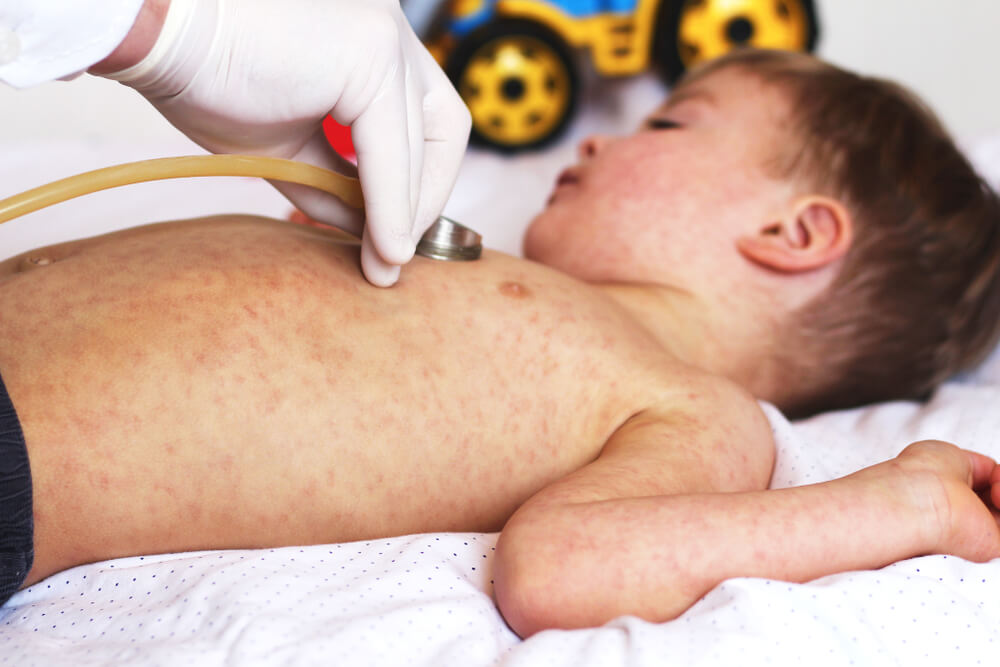
Rash: Characterised by small red spots clustered closely together; often first appears in the armpit and groin areas and on the inner thighs, and may spread to the whole body; as the skin peels, severe itching frequently occurs
Treatment: Antibiotic therapy, usually with penicillin for ten days; if necessary, measures to reduce fever and bed rest; other measures (e.g. gargle solutions for a sore throat, medically prescribed ointments for itching)
What causes scarlet fever?
Scarlet fever (scarlatina) is an exanthematous disease caused by infection with β-haemolytic streptococci. There are many types of streptococci that can cause scarlet fever. ‘Exanthematous’ means that the disease manifests itself as an acute, widespread rash.
It mainly affects children between the ages of three and ten*, but adults can also contract scarlet fever. Due to the wide variety of streptococcal pathogens that cause scarlet fever, there is no general immunity following an infection, which is why even adults who had scarlet fever as children can contract the disease again. Unlike other infectious diseases, there is currently no effective vaccine against scarlet fever.
How is the infection transmitted and when do symptoms appear?
Scarlet fever is caused by infection with β-haemolytic streptococci of the Lancefield Group A. Transmission occurs via droplet infection – meaning the bacteria are transmitted, for example, through coughing, sneezing or speaking, and are inhaled into the throat. The incubation period – that is, the time between the bacteria entering the body and the first symptoms appearing – is two to eight days*for scarlet fever.
What are the most common symptoms of scarlet fever?
Characteristic symptoms include inflammation of the tonsils (scarlet fever angina), a rash and what is known as ‘raspberry tongue’. The illness is also typically accompanied by a high fever. A sore throat, in particular, is almost always present; no other symptom of scarlet fever occurs as regularly as this one.
After the incubation period, the illness usually begins with a high fever, a sore throat and difficulty swallowing; the mucous membranes of the throat and soft palate are a dark red colour and the palatine tonsils are swollen. A typical symptom is the rash, which spreads around the second day of the illness. The skin often feels velvety or like sandpaper. The rash is characterised by closely clustered, pinhead-sized, red spots and can affect the whole body, although the ‘mouth-cheek-triangle’ remains unaffected (pale mouth triangle). The rash usually begins in the groin, armpits and on the inner thighs, and spreads from there. The rash does not usually cause itching.
Another characteristic symptom is ‘raspberry tongue’ – in the early stages of scarlet fever, the tongue has a white coating; from the third or fourth day onwards, it becomes noticeably reddened and develops small nodules. As the illness progresses, the rash gradually subsides, after which the skin begins to peel (including on the palms of the hands and soles of the feet). This peeling can last for several weeks and is often accompanied by severe itching.
In addition to a high fever, scarlet fever sore throat, a rash and a ‘raspberry tongue’, abdominal pain, vomiting, chills, headaches, aching limbs and other symptoms may also occur. The course of the illness can vary, ranging from a severe form with a high fever and a very pronounced rash to a mild form with only a few noticeable symptoms. Particularly in older people, it is also possible that not all the typical symptoms of the illness will be present, meaning that scarlet fever is not immediately recognised as such.
Typical strawberry tongue associated with scarlet fever

How is scarlet fever treated?
If scarlet fever is suspected, it is essential to consult a general practitioner or a paediatrician. Following a medical history, physical examination and a throat swab, the diagnosis can be confirmed by laboratory tests. Treatment involves antibiotics; it is also advisable to ensure a high fluid intake and to take fever-reducing medication if necessary. If the patient has a fever, bed rest is important. Gargle solutions, amongst other things, can help relieve the unpleasant sore throat. The peeling of the skin is sometimes accompanied by severe itching, which can be effectively treated with, amongst other things, medically prescribed ointments and homeopathic remedies.
Antibiotic treatment
Treatment usually involves taking the antibiotic penicillin for ten days. If you are allergic to penicillin, treatment will be carried out using a different antibiotic. It is important to take the antibiotic exactly as prescribed by your doctor and not to stop the course of treatment without consulting your doctor, as this could lead to a relapse. It is generally assumed that the risk of infection has passed around 24 hours after starting the antibiotic treatment; however, it is important to discuss the risk of infection with your doctor, who will also decide when you can return to school or work. Without specific treatment, those affected may remain infectious for several weeks.
What is the course of scarlet fever?
If antibiotics are administered early, the symptoms usually subside after a few days and, in most cases, those affected are fully recovered once treatment is complete. In some cases, however, or if treatment is inadequate, scarlet fever can take a severe course and lead to sinus infections, tonsil abscesses, kidney damage, septicaemia, rheumatic fever and other complications. Rheumatic fever can be accompanied by, amongst other things, joint pain and inflammation of the inner lining of the heart (endocarditis), and can also affect the brain. The earlier appropriate treatment is started, the lower the risk of such and other complications and long-term effects. Generally speaking, the risk of complications from scarlet fever is low; nowadays, the disease can usually be treated quickly and effectively with antibiotics.
What are the symptoms of scarlet fever in adults?
How can scarlet fever be prevented?
As there is no immunity against a recurrence of the disease and no vaccine against scarlet fever, the best way for people with a case of the disease in their family or circle of friends to protect themselves is to avoid contact with the infected person during the potential infectious period. If contact cannot be avoided, it is important to consistently follow certain precautionary and hygiene measures (avoid close contact, turn away when coughing or sneezing, and wash and disinfect hands regularly). To prevent infecting others, those affected should limit contact with other people as much as possible, turn away when coughing or sneezing, and avoid coughing or sneezing into their palms; instead, they should cough or sneeze into the crook of their elbow or into a tissue, which should be disposed of immediately afterwards.
Which doctor should you contact?
If you suspect that you or your child has scarlet fever, inform your doctor in advance. Scarlet fever is highly contagious and this is the only way to prevent contact with other people. A definitive diagnosis can be made by:
*Information may vary in the literature.
FAQ
Characteristic symptoms include inflammation of the palatine tonsils (scarlet fever angina), a rash and what is known as ‘raspberry tongue’. The illness is also typically accompanied by a high fever. A sore throat, in particular, is almost always present.
Scarlet fever is treated with antibiotics. It is also important to ensure a high fluid intake and, if necessary, to take fever-reducing medication.
Gargles, amongst other things, can help relieve the unpleasant sore throat. The peeling of the skin is sometimes accompanied by severe itching, which can be effectively treated with, amongst other things, medically prescribed ointments and homeopathic remedies.
Scarlet fever is an extremely contagious disease, and infection is spread via droplet transmission. The bacteria are therefore transmitted, for example, when coughing, sneezing or speaking, and are inhaled into the throat. The incubation period for scarlet fever is usually two to eight days.
Like chickenpox and measles, scarlet fever is one of the childhood illnesses. Children of nursery and primary school age are most commonly infected, but adults can also catch scarlet fever.
No, there is currently no vaccine against scarlet fever.


Watschinger R.; Profile: Streptococcus pyogenes, Universum Innere Medizin 04/2011, MedMedia Verlag und Mediaservice GmbH
Seedat D. et al.: Epidemiological Bulletin – current data and information on infectious diseases and public health 05/2009, Robert Koch Institute
Scarlet fever – information on human pathogens, Federal Centre for Health Education, as at 25 April 2016, URL: https://www.infektionsschutz.de/erregersteckbriefe/scharlach/
Wessels M.R.; Pharyngitis and Scarlet Fever, 25 June 2016, URL: https://www.ncbi.nlm.nih.gov/books/NBK333418/
Wülker D.; Five Cases of Scarlet Fever – from Mild to Fulminant, Medical Tribune, 5 August 2014, swissprofessionalmedia AG, URL: https://www.medical-tribune.ch/medizin/fokus-medizin/artikeldetail/fuenfmal-scharlach-von-mild-bis-fulminant.html
Streptococcus pyogenes infections, RKI Guide for Doctors, Robert Koch Institute, as at 12 March 2009, URL: https://www.rki.de/DE/Content/Infekt/EpidBull/Merkblaetter/Ratgeber_Streptococcus_pyogenes.html
https://www.sozialministerium.at/Themen/Gesundheit/Uebertragbare-Krankheiten/Infektionskrankheiten-A-Z/Scharlach.html, accessed: May 2024
https://www.rki.de/DE/Content/InfAZ/S/Scharlach/Scharlach.html, accessed: May 2024
https://www.gesundheit.gv.at/krankheiten/kinderkrankheiten/infektion/scharlach.html, accessed: May 2024