
What is thrombocytopenia?
When platelet counts are too low, there are fewer platelets in the blood than expected. Medically, this is known as thrombocytopenia or thrombopenia.
As platelets play a role in stopping bleeding, a significantly reduced platelet count can increase the risk of bleeding. This can lead, for example, to small pinpoint haemorrhages on the skin, nosebleeds, bleeding gums or an unusually high number of bruises.
At what point is the condition referred to as thrombocytopenia?
Thrombocytopenia is usually diagnosed when the platelet count falls below 150,000 per microlitre of blood. In adults, this value is often regarded as the lower limit of the reference range. However, the specified normal range may vary slightly depending on the laboratory.
Slightly reduced platelet counts often cause no symptoms. Many abnormal results are discovered by chance and are initially monitored over time. The situation is different if the count drops significantly, is very low or if signs of bleeding occur.
As a rough guide: with platelet counts below around 50,000 per microlitre, the risk of bleeding may increase, particularly in the event of injuries or surgical procedures. Very low levels, such as below 20,000 to 10,000 per microlitre, may be associated with an increased risk of bleeding even without any apparent cause and must be assessed by a doctor promptly.
What symptoms can occur with low platelet counts?
Low platelet counts do not always cause symptoms. Many people do not notice anything at first, particularly if the count is only slightly reduced. Thrombocytopenia usually becomes apparent when the blood’s ability to clot is impaired. It is one of the most common causes of bleeding.
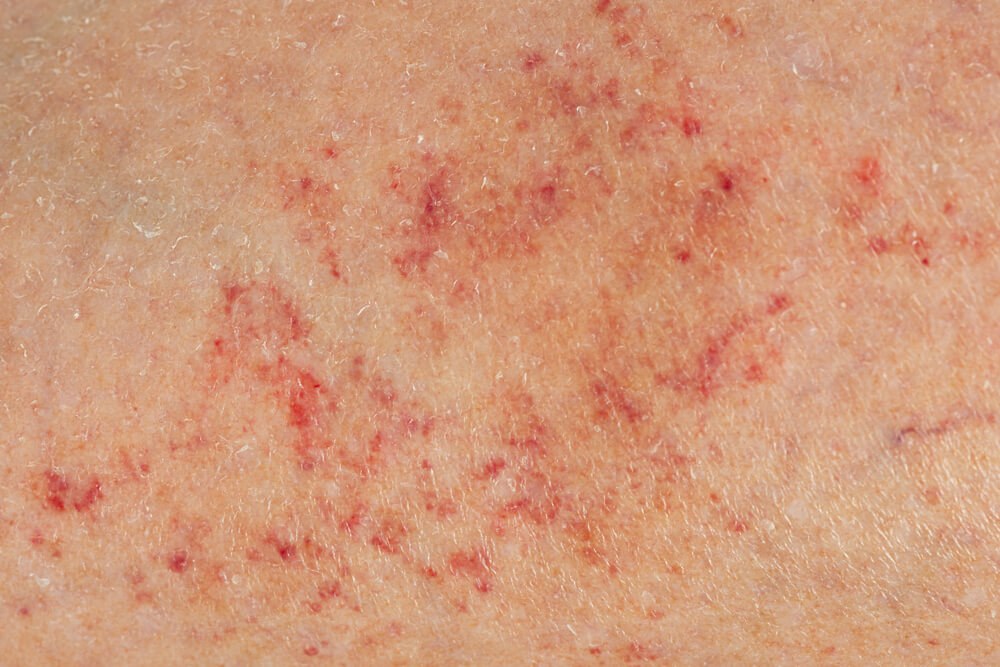
Typical signs include small, pinpoint haemorrhages in the skin and on the mucous membranes – known as petechiae. They look like red, purple or brownish spots and do not disappear when pressed with a glass or a finger. An unusually high number of bruises, frequent nosebleeds, bleeding gums or bleeding that lasts longer than usual may also occur.
In women, thrombocytopenia may also manifest as significantly heavier or prolonged menstrual bleeding. Less commonly, blood may be present in the urine or stools. Such symptoms should be investigated by a doctor, particularly if they are new, become more severe or occur alongside a significantly reduced platelet count.
When should you seek medical advice?
A low platelet count should be assessed by a doctor if it is significantly below the reference range, is a new development, or continues to fall during follow-up checks. It is also important to seek medical advice if other blood test results are abnormal.
The findings should be discussed with a doctor promptly if signs of bleeding develop. These include pinpoint skin haemorrhages, numerous new bruises, frequent nosebleeds or bleeding gums, blood in the urine or stools, and very heavy or unusually prolonged menstrual bleeding.
Prompt medical attention is essential if bleeding is severe, does not stop, or occurs without any apparent cause. Severe headaches, visual disturbances, confusion, shortness of breath, chest pain or a marked deterioration in general health should also be taken seriously.
What causes low platelet counts?
Low platelet counts can have various causes. Broadly speaking, there are three possibilities: the body produces too few platelets; platelets are being used up or destroyed at an increased rate; or they are being stored in the spleen in greater quantities.
There may be too few platelets in the body if the bone marrow is not producing enough of them. Possible reasons include certain bone marrow disorders or malignant blood disorders such as leukaemia. Chemotherapy, radiotherapy, severe viral infections, high alcohol consumption or a deficiency in vitamin B12, folic acid or iron can also play a role.
In cases of increased consumption, platelets are used up in the body faster than they can be replenished. This can occur, for example, in the case of infections, autoimmune reactions, certain medicines, rare clotting disorders or following blood transfusions. Severe acute illnesses, in which the clotting system is strongly activated, can also lead to a high consumption of platelets.
One important subtype is immune thrombocytopenia, or ITP for short. In this condition, the immune system attacks platelets or their precursor cells. In rare cases, heparin can also trigger a specific form of thrombocytopenia. This so-called heparin-induced thrombocytopenia, or HIT for short, requires prompt medical assessment.
Another possibility is that too many platelets accumulate in an enlarged spleen. In this case, fewer platelets are detectable in the blood, even though the body is not necessarily producing too few. This can occur, for example, in certain liver diseases or conditions involving an enlarged spleen. Acute bleeding can also contribute to low platelet counts.
The platelet count alone does not provide a definitive indication of the actual underlying cause. It is therefore important to consider symptoms, medication, pre-existing conditions, other blood test results and the trend in the platelet count.
Thrombocytopenia during pregnancy
During pregnancy, platelet counts may fall slightly. This is not unusual at first: changes in blood volume and increased platelet turnover lead to a mild drop in levels in many pregnant women.
This pregnancy-associated thrombocytopenia is also known as gestational thrombocytopenia. It is usually mild, causes no symptoms and generally does not pose an increased risk to the mother or baby. After the birth, the platelet count usually returns to normal on its own within a few days or weeks.
The key factors to consider are the extent of the reduction, whether the thrombocytopenia occurs early in pregnancy, whether there are signs of bleeding, and whether other blood test results are abnormal. Particularly in cases of significantly low platelet counts, a tendency to bleed, high blood pressure, upper abdominal pain, headaches, visual disturbances or abnormal liver function tests, a more detailed investigation should be carried out to determine whether there is another underlying cause. These include, for example, pre-eclampsia, HELLP syndrome, immune thrombocytopenia or other conditions.
In cases of mild pregnancy-associated thrombocytopenia, regular monitoring of the blood count is usually sufficient. If the platelet count drops more significantly, treatment depends on the cause and on whether there is an increased risk of bleeding.
Low platelet counts in children
Platelet counts can also be temporarily too low in children. A low count is often noticed in the context of an infection or during a blood test carried out for another reason. Not every abnormality immediately indicates an underlying serious condition.
A major cause in children and adolescents is immune thrombocytopenia, or ITP for short. It is the most common acquired cause of a tendency to bleed in children and adolescents. In this condition, the immune system attacks the blood platelets. In many cases, ITP in children does not last long and does not always require treatment with medication. Life-threatening bleeding is rare.
A low platelet count should be investigated by a paediatrician, particularly if it is significantly low, continues to fall during follow-up checks, or if signs of bleeding occur. If petechiae occur alongside a fever or a significantly poor general condition, medical help should be sought immediately.
Pseudothrombocytopenia: Can the count be falsely low?
Yes, a platelet count can sometimes only appear to be too low. This is referred to as pseudothrombocytopenia. A common form is EDTA-induced pseudothrombocytopenia. In this case, there are not necessarily too few platelets in the body. The laboratory result simply appears lower than it actually is.
This can happen if platelets clump together in the sample tube after the blood has been drawn. The laboratory analyser then counts fewer individual platelets, even though there may actually be sufficient platelets in the blood.
If a value suddenly deviates significantly, does not correspond to the symptoms, or varies greatly during follow-up tests, it may be advisable to take another blood sample. Often, a different tube is then used, or the blood is additionally examined under a microscope.
How is thrombocytopenia diagnosed?
If platelet counts are too low, the result is usually not assessed in isolation. Doctors first assess the overall picture:
- How low is the count?
- Has it occurred recently or has it been present for some time?
- Are there any signs of bleeding, an infection, new medication, a pregnancy or pre-existing conditions?
This also includes a physical examination and a detailed medical history. Important factors include, for example, previous episodes of bleeding, existing medical conditions, the use of certain medicines and any possible infections in recent weeks.
Often, the blood count is checked or repeated as a first step. Other values are also assessed, such as red and white blood cells, the differential blood count, inflammatory markers, liver and kidney function tests, coagulation parameters, as well as vitamin B12 and folic acid levels. This makes it easier to determine whether only the platelets are affected or whether there are other abnormalities.
If the results are unclear, a blood smear may be useful. This involves examining the blood under a microscope. This allows the doctor to see, for example, whether platelets are clumped together, whether their size is abnormal, or whether other blood cells appear altered.
Depending on the suspected cause, further investigations may follow, such as tests for infections, autoimmune disorders or nutritional deficiencies. Sometimes the spleen or liver is also examined using ultrasound. In cases of prolonged thrombocytopenia, additional tests for infections such as HIV, hepatitis B or hepatitis C may be advisable.
A bone marrow examination is only necessary in certain cases, for example if the cause remains unclear, if other blood cells show abnormal changes, or if a bone marrow disorder needs to be ruled out.
How is thrombocytopenia treated?
How thrombocytopenia is treated depends primarily on the cause, the level of platelets and any symptoms present. Treatment therefore does not automatically target the figure in the laboratory results, but rather the underlying condition.
In cases of slightly reduced platelet counts with no signs of bleeding, regular monitoring over time is sometimes sufficient. Doctors will then check whether the count returns to normal, whether an infection is the underlying cause, whether medication is a factor, or whether other blood test results are abnormal.
If the count is significantly low or if bleeding occurs, a more rapid assessment is important. Depending on the cause, different treatments may be necessary. These include, for example, adjusting certain medicines, treating an underlying condition, or using medicines that affect the immune system.
In cases of very low levels, severe bleeding or prior to certain procedures, a platelet transfusion may also be necessary in some situations. For specific causes, other treatments may be considered, such as blood plasma therapy, treatment for an underlying spleen or bone marrow disorder, or other specialised procedures. Doctors decide which treatment is appropriate based on the cause and the risk of bleeding.
It is also important to note that any known thrombocytopenia must be disclosed before operations, punctures or major dental procedures. This enables doctors to plan measures in good time to minimise the risk of bleeding as much as possible.
Can thrombocytopenia be prevented?
There is very little that can be done to prevent thrombocytopenia. The possible causes are simply too varied. Sometimes platelet counts drop temporarily due to an infection, during pregnancy or as a result of certain medicines. In other cases, it is caused by disorders of the blood, liver, spleen or immune system.
Above all, it is advisable to ensure that any known underlying conditions are properly managed and to have any abnormal blood test results checked. Medicines should only be taken as prescribed. Stopping a course of treatment or changing the dose should always be discussed with a doctor, particularly in the case of anticoagulants or medicines that may affect blood formation.
A balanced diet can support blood formation. Nutrients such as vitamin B12 and folic acid are important in this regard, particularly if a deficiency is actually present. However, this does not generally prevent thrombocytopenia. If signs of bleeding occur or the platelet count is significantly low, this should be investigated by a doctor.





