
When your smartwatch suddenly goes off
It usually happens just when you least expect it. You’re sitting at your desk, out at the supermarket or lying on the sofa in the evening, and suddenly you glance at your wrist. The smartwatch shows an unusually high heart rate. Or it reports an ‘irregular heart rhythm’.
Many people describe a similar sensation in such situations. Your body suddenly feels more present. You feel your own heartbeat more strongly than before, paying closer attention to every slight flutter, every faint twinge or any change in rhythm. And this is precisely where the real problem begins – not with the number itself, but with what it triggers: uncertainty.
After all, the smartwatch provides a specific reading, sometimes even accompanied by a clearly worded warning. What it doesn’t provide is context. What does this reading actually mean right now? Is it caused by exercise, stress, a measurement error, or is there something else behind it? Most of these situations ultimately have a harmless cause. Nevertheless, at first it often doesn’t feel that way.
How reliable are smartwatch measurements?
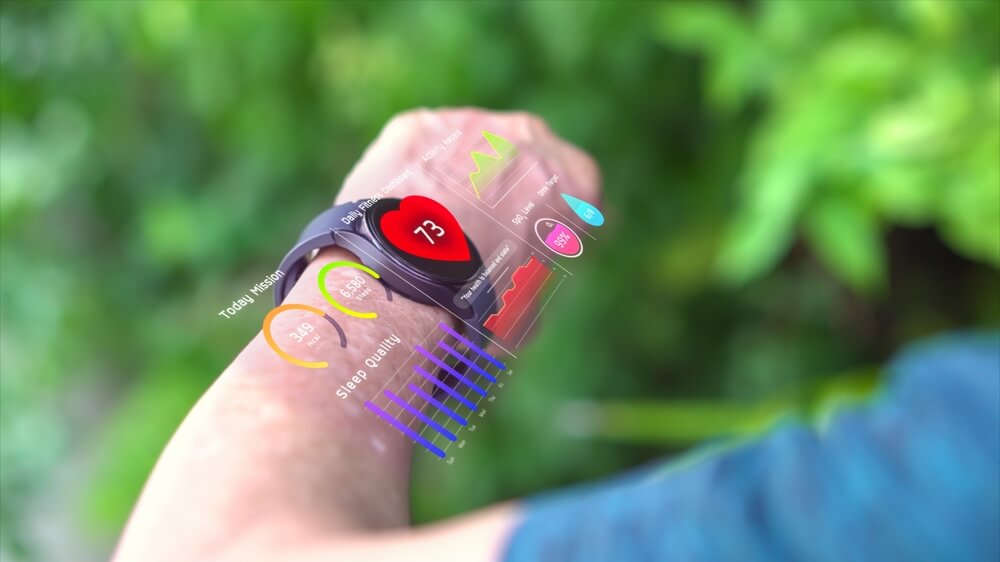
Smartwatches often seem astonishingly precise in everyday life. The readings change in real time, the graphs look ‘medical’, and warning messages are often clearly worded. This quickly gives the impression that they are highly accurate measuring devices.
The reality, however, is somewhat more nuanced. Most smartwatches do not measure the heart rate directly at the heart, but using optical sensors on the wrist. This method relies on light: it is shone onto the skin and the device analyses how strongly it is reflected by the blood flow. The device then calculates the heart rate from these changes.
This method works well in many everyday situations, particularly at rest or during steady exercise. That is why heart rate trends throughout the day are often quite reliable.
Things become more difficult at times when many people pay particularly close attention to the readings. Deviations can occur during exercise, when under stress, or when there are rapid changes in daily life.
Typical causes of this include, for example:
- the watch sitting loosely on the wrist
- rapid arm movements
- cold hands or reduced blood circulation
- intense physical activity
- the body’s stress responses
In such situations, the measured heart rate may temporarily be higher or lower than it actually is. Not because the device is ‘faulty’, but because the measurement method has reached its limits.
This means that smartwatches are very good at showing trends and patterns, but are not always perfect at providing medically accurate snapshots of individual readings. This is precisely why context is crucial. A single reading tells us very little. Only the trend over time provides a realistic picture.
How can you measure your heart rate as accurately as possible with a smartwatch?
Even though smartwatches automatically monitor your heart rate in the background, the accuracy depends heavily on how they are worn and used. This is because the technology behind the measurement is sensitive to external factors, and it is precisely these that often determine whether a reading is reliable or not.
Most models use optical sensors on the wrist. For these to measure correctly, the watch must make firm contact with the skin. If it is too loose, movements can interfere with the signal. If it is too tight, it can affect blood circulation. Position also plays a role: a reading taken directly on the wrist bone is often less accurate than one taken slightly higher up on the forearm.
In practice, this means:
- Wear the watch two fingers’ width above the wrist.
- It should fit snugly but still be comfortable and not slip.
- Warm hands improve the quality of the measurement, as cold skin reduces blood flow and weakens the signal.
- When doing sport, it’s worth starting the measurement a few minutes before your workout so that the readings can stabilise.
- During very intense or fast-paced exercise, such as interval training or strength training, a chest strap is generally more accurate than a smartwatch.
- Cleaning the sensor regularly can also help to maintain a stable signal quality.
What is a ‘normal’ heart rate?
At first glance, the question seems simple: surely a normal heart rate must be a clearly defined value, much like body temperature or certain laboratory test results. In reality, however, it is more complicated. The heart rate is not a fixed standard value, but a dynamic measurement that constantly adapts to the body’s current condition.
It is influenced by factors including:
- age
- physical fitness
- Gender
- Time of day
- stress levels
- Medication and medical conditions
For this reason alone, there is no single ‘normal value’ that applies equally to everyone.
A rough guide to resting heart rate in adults
| Resting heart rate | Classification |
|---|---|
| 40–60 beats per minute | often normal for well-trained endurance athletes |
| 60–80 beats per minute | typical reference range for many adults |
| 80–100 beats per minute | May still be acceptable depending on the situation and the individual |
| Over 100 beats per minute at rest | Elevated resting heart rate (tachycardia) – seek medical advice if readings persist |
| Below 40–50 beats per minute with symptoms | May require treatment – particularly in cases of dizziness, fainting or a sudden drop in performance |
Differences depending on life circumstances
- On average, women have a slightly higher resting heart rate than men (approx. +3–7 bpm).
- Pregnant women often have an elevated resting heart rate (approx. +10–20 bpm).
- Children and adolescents generally have higher heart rate ranges than adults.
- People who are physically fit may have significantly lower resting heart rates over the long term without being unwell.
Even minor everyday factors can significantly alter your heart rate. For example, when you climb stairs, your heart rate automatically increases. If you are nervous or feeling under pressure, your body reacts in a similar way. Even coffee, lack of sleep or a mild infection can affect the reading.
This means that two people can have the same heart rate of 90 and yet be in completely different circumstances. The trend over time is therefore more important than a single reading. The body does not operate in snapshots, but in patterns. It is precisely these patterns that doctors assess later on.
High heart rate on a smartwatch – when does it become a cause for concern?
A sudden spike in heart rate often looks more dramatic on a smartwatch than it actually is from a medical point of view. This is mainly because the figure appears out of context: 140, 160 or even 180 beats per minute on the display, but with no explanation as to why this reading is occurring at that moment.
This is precisely where uncertainty sets in for many people.
After all, a high heart rate is not, in itself, a diagnosis, but rather a reaction by the body. The heart constantly adjusts its rate to the current situation, usually faster than we are consciously aware of.
In many cases, there are completely harmless triggers for this. Physical activity is the most obvious one. Even brisk walking, climbing stairs or carrying shopping bags can significantly raise your heart rate. But less obvious factors also play a role: stress, inner tension, caffeine or even getting worked up during a conversation.
The body does not distinguish between ‘physical’ and ‘emotional’ strain. For the heart, both are forms of stimulation.
Common harmless causes of a high heart rate
- Exercise or sport
- Stress or nervousness
- Caffeine
- Dehydration
- Fever or the onset of an infection
In these situations, an elevated heart rate is a normal physiological response.
The situation only becomes more serious if the high heart rate persists for a prolonged period whilst you are completely at rest, or if additional symptoms occur. These include, for example, chest pain, shortness of breath, severe dizziness or a pronounced feeling of weakness.
In such cases, it is advisable to seek medical advice, regardless of what the smartwatch actually displays. This is because it is not the individual reading that matters, but the overall picture comprising the measurement, the situation and how you feel physically.

Low heart rate on your smartwatch – when is it normal, and when isn’t it?
A low heart rate on your smartwatch can be worrying. This is particularly true if the smartwatch suddenly displays readings of 40 beats per minute or even lower during the night.
In this situation, many people ask themselves: is this normal? As is so often the case, the answer is: it depends. A low heart rate isn’t automatically a warning sign. On the contrary, in many situations it simply indicates that the body doesn’t need to work very hard at that moment.
Many bodily functions slow down, particularly whilst sleeping. Oxygen demand falls, the metabolism runs at a slower pace, and the heart also beats more slowly. That’s why low heart rates at night are often completely normal.
The same applies to people who regularly take part in endurance sports. A well-trained heart works more efficiently and can supply the body with sufficient blood even with fewer heartbeats. That is why many endurance athletes have a consistently lower resting heart rate without any underlying medical condition.
Typical situations in which a low pulse may be normal
- during sleep or in periods of deep rest
- when practising endurance sports regularly
- when lying down in a relaxed position
- in cases of genetically determined low heart rate
When should a low pulse be investigated by a doctor?
A low pulse only becomes a cause for concern if it is accompanied by symptoms. These include, in particular:
- Dizziness or light-headedness
- Fainting spells or near-fainting
- Persistent severe tiredness
- A noticeable decline in performance in everyday life
In these cases, you should seek medical advice, as a low heart rate may be part of an underlying medical condition.
What the smartwatch cannot detect
The measurement method itself also plays a role. Smartwatches measure the pulse optically on the wrist. Particularly at night, when the watch shifts position unnoticed or the arm is positioned awkwardly, individual readings may be inaccurate. A pulse reading of 38 or 40 beats per minute displayed for a short time therefore does not automatically mean that the heart has actually been beating that slowly all along.
So here too, the key point is this: it is not the individual reading that matters, but the trend over several days and how you feel physically.
Can a smartwatch detect atrial fibrillation or cardiac arrhythmia?
If the watch suddenly reports an ‘irregular heart rhythm’, this can quickly sound like a definitive diagnosis. In reality, however, such a notification is initially merely an indication that the heart rhythm shows abnormalities which should be investigated further.
Some modern smartwatches can indeed detect such abnormalities. To do this, they use either optical heart rate monitoring or, in certain models, a built-in ECG function. This records what is known as a single-lead ECG and can provide indications of atrial fibrillation. However, it is important to understand what this measurement can and cannot do.
A single-lead ECG provides only a small snapshot of the heart’s electrical activity. It is therefore no substitute for a 12-lead ECG, such as that carried out in a doctor’s surgery or hospital. Many other types of cardiac arrhythmia cannot be reliably detected or ruled out using this method.
What does this mean in practice?
Studies show that certain smartwatches can often reliably detect signs of atrial fibrillation. They can therefore help to identify previously undetected cardiac arrhythmias at an early stage.
At the same time, false alarms are possible. Movement during the measurement, unfavourable measurement conditions or harmless fluctuations in heart rhythm can cause the watch to issue a warning even though there is no heart rhythm disorder requiring treatment. Conversely, an existing arrhythmia may also go undetected. For this reason, experts recommend that smartwatch measurements be viewed as a screening tool, but not as a diagnostic tool.
Important to know
- Smartwatches can provide indications of atrial fibrillation.
- However, they can neither confirm nor rule out heart rhythm disorders with certainty.
- A diagnosis can only be made through a medical examination, usually involving an ECG.

When should you really see a doctor?
A smartwatch can raise awareness, but it can sometimes also cause anxiety. It cannot assess whether a reading is medically significant or not. This is precisely why the crucial question arises: when is it enough simply to monitor the readings, and when should you seek medical advice?
As a general rule, it is not a single reading that is decisive, but the combination of trends, context and physical symptoms.
If the readings are unusual but there are no symptoms
In many cases, abnormal smartwatch readings are harmless, particularly if:
- the heart rate is only elevated for a short time and returns to normal
- no symptoms are present
- the change is clearly linked to exercise, stress, caffeine or similar triggers
- the resting heart rate remains stable overall
In such situations, there is good reason to monitor the readings initially and observe how they develop over a few days. Isolated outliers are usually not indicative of any medical condition.
If readings are repeatedly abnormal
The situation is different if certain abnormalities do not occur just once, but recur. A medical assessment is advisable if:
- the resting heart rate is repeatedly significantly elevated
- ‘irregular heart rhythm’ alerts occur repeatedly
- the smartwatch frequently displays unusual readings without any clear trigger
In this context, the focus is less on acute danger and more on safety. The aim is to determine whether there is an explainable cause behind the readings or whether further diagnostic tests are warranted.
If symptoms are present
It is particularly important to seek medical advice if physical symptoms accompany the smartwatch readings. These include:
- Chest pain or a feeling of pressure in the chest
- Shortness of breath
- severe dizziness
- Fainting or feeling as though you are about to faint
- severe, sudden weakness
If such symptoms occur, the situation should be taken seriously, regardless of the smartwatch. At such times, the watch merely provides additional information; however, the decision should always be based on the overall picture of the symptoms.





