
What does high blood pressure mean for children and young people?
High blood pressure is considered a widespread condition amongst adults. However, elevated blood pressure readings are also becoming increasingly common amongst children and adolescents. One major risk factor is being overweight: whilst around two to three per cent of children of normal weight are affected by high blood pressure, the proportion rises to as much as 25 per cent amongst severely overweight adolescents.
Other factors can also increase the risk. These include a family history of the condition, being born prematurely, and chronic diseases of the heart, lungs or kidneys. Diabetes, sleep apnoea, organ transplants and certain medicines can also play a role. Nicotine and drugs can also raise blood pressure. Coffee and energy drinks, in particular, lead to a temporary rise in blood pressure.
It is therefore important to keep an eye on these risk factors and to monitor children’s blood pressure readings in good time. This allows abnormal readings to be identified early on and any possible causes to be treated specifically.
What blood pressure readings are normal for children?
Unlike in adults, there is no single normal blood pressure reading for children. Normal readings increase with age and height. Doctors therefore use so-called percentile curves to assess the readings. These take into account the child’s age and height.
| Under 16 years of age | From 16 years of age | |
|---|---|---|
| Normal | < 90th percentile | < 130/80–84 |
| High normal | 90th–94th percentile | 130–139/85–89 |
| Stage 1 hypertension | 95th–99th percentile + 5 mmHg | 140–159/90–99 |
| Stage 2 hypertension | 99th percentile + 5 mm Hg | 160–179/100–109 |
What symptoms does high blood pressure cause in children?
High blood pressure often causes no symptoms in children and therefore frequently goes unnoticed for a long time. If symptoms do occur, they are usually non-specific.
These may include:
- recurrent or persistent headaches
- dizziness
- nosebleeds
- nausea and vomiting
- blurred or impaired vision
- Difficulty concentrating or learning
- Ringing in the ears
- Chest pain or palpitations
If blood pressure is very high, shortness of breath, seizures, confusion, numbness or movement disorders may also occur. Such symptoms must be assessed by a doctor immediately.
What causes high blood pressure in children?
When children develop high blood pressure, the process of identifying the cause differs from that in adults. Whilst adults usually have primary hypertension, in children the younger the child, the more likely it is that a specific organic condition is behind the high blood pressure. In this case, it is referred to as secondary hypertension.
High blood pressure is rare in infants and young children. When it does occur, it is often a case of so-called secondary hypertension. The high blood pressure is then caused by another condition. Conditions or malformations of the kidneys, the renal vessels, the heart or the large blood vessels are particularly common.
Among school-age children, the pattern is gradually shifting. Organic conditions, particularly kidney diseases, continue to play a significant role. At the same time, primary hypertension is becoming increasingly common in this age group, often in conjunction with being overweight. In adolescents, the picture increasingly resembles that seen in adults. Here, primary hypertension usually predominates. Being overweight, a lack of physical activity, a high-salt diet and a family history of the condition are among the most significant contributing factors.
Primary hypertension
Primary hypertension is also known as essential hypertension. No single organic cause can be identified. Rather, it arises from a combination of genetic predisposition and various lifestyle and risk factors.
The most significant risk factors include:
- Being overweight and obesity: This is by far the strongest risk factor.
- Family history
- Lack of physical activity
- A high-salt diet
- Premature birth or low birth weight
- Medical conditions during pregnancy: High blood pressure or pre-eclampsia in the mother may be associated with an increased risk for the child.
- Metabolic syndrome: This involves the combined presence of several risk factors, such as being overweight, elevated blood sugar or blood lipid levels, and high blood pressure.
- Obstructive sleep apnoea
Secondary hypertension
In secondary hypertension, high blood pressure is caused by another medical condition or a specific external factor. Possible triggers include kidney, heart, vascular, hormonal or metabolic disorders. Disorders of the kidneys or renal blood vessels are particularly common.
Possible kidney-related causes include:
- Glomerulonephritis: This refers to various acute or chronic conditions affecting the glomeruli (clusters of blood vessels) in the kidneys, which impair kidney function and raise blood pressure.
- Chronic kidney disease: Persistently impaired kidney function is often accompanied by high blood pressure.
- Polycystic kidney disease: In these conditions, which are usually hereditary, numerous cysts form in the kidneys. High blood pressure can also occur in this condition.
- Reflux nephropathy: This occurs when urine flows back from the bladder towards the kidneys, causing long-term damage to the kidney tissue.
- Renovascular diseases: In these conditions, the blood vessels of the kidneys are narrowed or altered. The reduced blood flow triggers the body’s own regulatory mechanisms, which raise blood pressure.
Other causes
Other possible causes include:
- Heart and vascular diseases, such as narrowing of the aorta
- rare genetic disorders
- hormonal disorders, such as hyperthyroidism or excessive cortisol production
- certain medicines, including cortisone preparations, hormonal contraceptives, methylphenidate and immunosuppressants
- the use of nicotine, alcohol or drugs
Risk factors: Which children are at increased risk?
Some children are at greater risk of developing high blood pressure. The main contributing factors include certain pre-existing conditions, a family history of the condition, specific circumstances surrounding birth, as well as being overweight and having unhealthy lifestyle habits.
There is a particularly high risk in cases of:
- chronic conditions, including kidney disease, congenital heart and vascular conditions, diabetes mellitus and obstructive sleep apnoea
- a family history of the condition, for example if parents or close relatives have high blood pressure or have suffered a heart attack or stroke at an early age
- premature birth or very low birth weight
- high blood pressure or pre-eclampsia in the mother during pregnancy
- overweight or obesity
- a marked lack of physical activity
- a consistently high-salt diet
- Excessive consumption of caffeinated energy drinks
- taking certain medicines that affect blood pressure
How dangerous is high blood pressure?
High blood pressure is dangerous primarily because it often goes unnoticed for years. It usually causes no pain, but can put strain on blood vessels and organs in the long term. In children, serious complications such as heart attacks or strokes are very rare.
Nevertheless, the first signs of damage to health can appear even at a young age:
- Heart failure: The heart has to pump continuously against high resistance. As a result, the heart muscle thickens, eventually becomes worn out and loses strength.
- Organ damage: The fine blood vessels in the kidneys and eyes, in particular, suffer severe damage.
- Long-term consequences: High blood pressure in childhood and adolescence often persists into adulthood and increases the risk of a heart attack or stroke later in life.
How is blood pressure measured correctly in children?
To ensure reliable blood pressure readings, the measurement must be adapted to the child’s age and height.
For infants and young children, blood pressure should be measured whilst they are lying down.
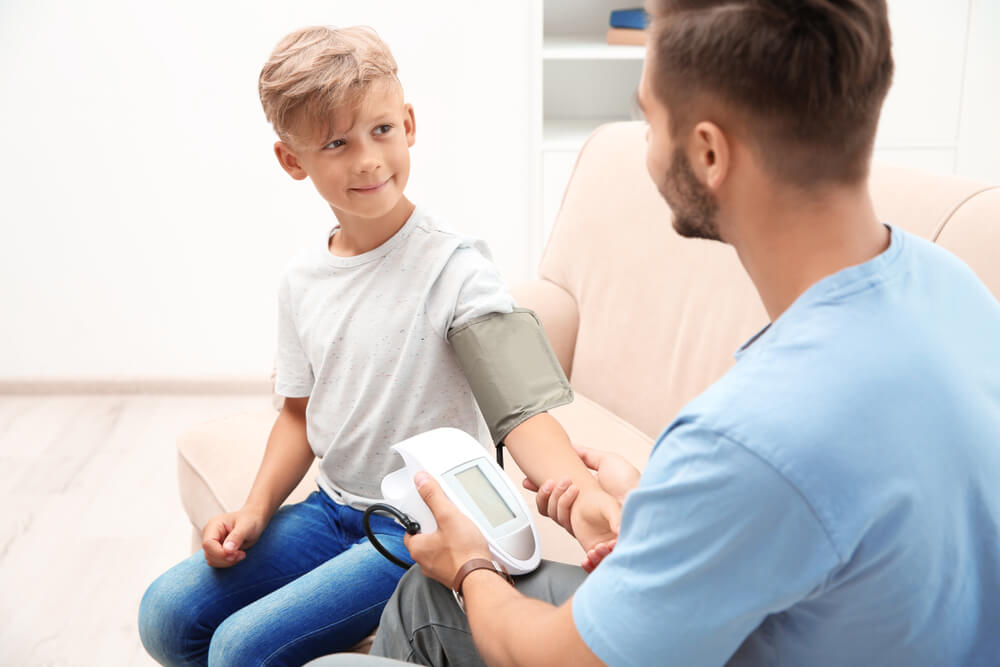
Older children should sit upright on a chair with their forearm resting relaxed on a support. Their back should be against the backrest as much as possible, and their legs should not be crossed. The arm should rest relaxed on a support so that the cuff is approximately at heart level.
The correct cuff size is crucial. It depends on the circumference of the upper arm and not solely on the child’s age. The cuff should cover 80–100 per cent of the upper arm’s circumference. Before the measurement, the child should rest for about five minutes. During the measurement, they should sit still, not speak and move as little as possible. If the reading is abnormal, the measurement should be repeated after a further rest period.
At what age should blood pressure be measured?
In healthy children, blood pressure should be checked regularly as part of routine health check-ups from the age of four. If the readings are normal and there are no particular risks, the AWMF guidelines state that a measurement approximately every two years is sufficient.
If there are specific risks, such as extreme prematurity, a congenital heart defect, kidney disease or the use of medication that affects blood pressure, blood pressure should be monitored earlier and on a regular basis. Depending on the condition, this may be necessary as early as infancy.
Which devices are suitable?
It is generally recommended to use blood pressure monitors that have been approved by the European Society of Hypertension (ESH) or the German Hypertension League. A list of recommended devices can be found on the German Hypertension League’s website. (https://www.hochdruckliga.de/betroffene/bluthochdruck-bei-kindern)
Most monitors now use electronic measurement and are therefore well suited for home use. Auscultatory measurements, where the doctor measures blood pressure using a stethoscope, are still recommended for use in the doctor’s surgery.
Which doctor should you consult if your child has high blood pressure?
If blood pressure readings are repeatedly abnormal, the paediatrician is the first point of contact. The first step is to check whether the blood pressure has been measured correctly and whether the readings remain elevated in subsequent measurements. To confirm the diagnosis, a 24-hour ambulatory blood pressure monitoring may be necessary.
If high blood pressure is confirmed, this is followed by a detailed interview, a physical examination and further investigations. These may include blood and urine tests, an ultrasound scan of the kidneys and an examination of the heart. In cases of very high blood pressure readings, younger children or indications of an organic cause, further investigation usually takes place in a specialist paediatric outpatient clinic. Depending on the suspected condition, specialists in paediatric nephrology or paediatric cardiology are typically involved.

How is high blood pressure diagnosed in children?
High blood pressure is diagnosed differently in children and adolescents than in adults, as normal values depend on age, gender and height. Blood pressure is measured several times using a cuff suitable for the upper arm, under standardised conditions.
A single elevated reading is not sufficient for a diagnosis. If the readings are abnormal, the measurements are repeated at intervals of a few days to weeks. For children under 16, the results are compared with so-called reference percentiles. If blood pressure is repeatedly above the 95th percentile, high blood pressure is suspected. This means that fewer than five per cent of comparable children have blood pressure that is equally high or higher. From the age of 16, fixed thresholds apply.
To confirm the diagnosis, a 24-hour ambulatory blood pressure monitoring test is carried out. During this test, a portable device measures blood pressure at regular intervals throughout the day and night. Among other things, this helps to determine whether the readings are only elevated in the doctor’s surgery. This phenomenon is known as white-coat hypertension or white-coat syndrome.
If high blood pressure is confirmed, further investigations will follow depending on the findings. These may include blood and urine tests, as well as ultrasound scans of the kidneys and heart. These help to identify possible causes and any existing organ damage.
How is high blood pressure treated in children?
For all affected children and adolescents, a change in lifestyle is recommended as a first step. This includes a healthy and balanced diet, regular exercise and age-appropriate sport.
If lifestyle changes have not been sufficiently successful after six months, medication is also started. If targeted treatment of the underlying condition is not possible, the first-line medications are usually an ACE inhibitor, an angiotensin receptor blocker or a calcium channel blocker. The choice of suitable medication depends, amongst other things, on the patient’s age, any underlying conditions and the cause of the high blood pressure.
Please note: Drug treatment should be initiated from the outset if:
- stage 2 hypertension is present
- the high blood pressure is caused by another condition
- the high blood pressure is causing symptoms
- there is already evidence of damage to the heart, kidneys, eyes or blood vessels
- diabetes mellitus is also present

Prevention: The best tips for everyday life
To prevent high blood pressure in children and young people as far as possible, or to lower slightly elevated readings without medication, a healthy foundation in everyday family life helps.
1. Diet
- Cut down on salt: Pay particular attention to ready meals, salty snacks, fast food and processed meat. Cook fresh meals as often as possible.
- Cut down on sugar: Soft drinks and iced teas contain a lot of sugar and can contribute to being overweight. Children should also only drink fruit juices in small quantities. Water and unsweetened teas are the best choice.
- Choose foods rich in potassium: A diet rich in potassium can have a beneficial effect on blood pressure. Potassium is found in potatoes, vegetables, pulses, fruit and nuts, amongst other things.
2. Exercise
- Be active every day: Children should be active for at least one hour every day, to the extent that they work up a light sweat.
- Limit screen time: Long periods of sitting should be regularly broken up with physical activity.
- Set a good example: Plan active family outings and shared exercise sessions instead of long afternoons on the sofa.
3. Weight, sleep and prevention
- Maintain a healthy body weight: Overweight and obesity are among the most significant modifiable risk factors for high blood pressure in childhood.
- Get enough sleep: Chronic sleep deprivation can take a toll on health and increase the risk of high blood pressure.
- Attend check-ups: According to guidelines, blood pressure should be measured as part of paediatric check-ups from the age of four. For children with specific risk factors, regular checks are necessary even earlier.





