
What are edamame?
Edamame are a type of legume and consist of young, unripe soya beans harvested whilst still in their pods. They resemble pea pods in appearance. However, only the beans inside are eaten, not the pods. They have a mild, slightly sweet and nutty flavour. Their texture is soft, yet pleasantly firm to the bite.
Like other pulses, edamame should not be eaten raw. When raw, they contain substances that are difficult to digest, which are only rendered harmless by heating. It is therefore important to boil or steam edamame before eating them.
Where do edamame come from?
Edamame originate from East Asia, primarily Japan, China and Korea. There, they have been prized as a food for centuries and are an integral part of traditional cuisine. In Japan in particular, edamame are frequently served as a snack or side dish.
In recent decades, edamame have also become popular outside Asia. Today, they are grown in many countries, including the USA and parts of Europe. Thanks to global trade, edamame are now available all year round, usually in frozen form.
What is the difference between edamame and soya beans?
The difference between edamame and soya beans lies primarily in the time of harvest and their use.
Edamame are young soya beans that are harvested before they are fully ripe. At this stage, the beans are still green, soft and juicy. They are available fresh or frozen.
Mature soya beans remain on the plant for longer. They are hard, yellowish or brownish in colour and are dried after harvesting. They are then processed further, for example into tofu, soya drinks, soya sauce or miso.
There are also differences in flavour. Edamame have a mild, slightly nutty taste, whilst mature soya beans are significantly stronger and more bitter. As a result, edamame are well suited as a snack or side dish, whilst mature soya beans are primarily used as a base ingredient for various soya-based foods.

Nutritional values – What nutrients do edamame contain?
Edamame provide a combination of plant-based protein, fibre and various vitamins and minerals. Particularly noteworthy is their comparatively high protein content, which makes them a popular plant-based source of protein.
Furthermore, edamame contains dietary fibre, which can aid digestion. It also contains small amounts of vitamins A, C and E. In terms of minerals, edamame provides, amongst others, iron, calcium, magnesium and potassium, which are involved in numerous metabolic processes.
Compared to many other snacks, edamame are also relatively low in calories. They contain just 6.8 g of fat per 100 grams and very little saturated fat. Thanks to this composition, they can be easily incorporated into a balanced diet.
These are the average nutritional values of edamame (100 g)
The nutritional information for edamame is based on average values. These may vary slightly depending on the variety, origin and method of preparation, and are provided for guidance only.
| Nutrients | Amount |
|---|---|
| Calories | approx. 149 kcal |
| Protein | 11.9 g |
| Fat | 6.8 g |
| Carbohydrates | 10.4 g |
| Fibre | 4.2 g |
Who should be cautious about eating edamame?
Edamame are generally well tolerated by most people. However, there are certain groups of people who should exercise caution when consuming them.
People with a soya allergy should avoid edamame. As edamame are young soya beans, they can trigger allergic reactions. These range from skin reactions to more severe symptoms. Around 3 per cent of the population is affected by a soya allergy.
If you have a sensitive digestive system, it may also be advisable to start by eating edamame in small quantities. The fibre content can cause bloating or a feeling of fullness in some people, particularly if pulses are not usually part of their diet.
If you have high uric acid levels or gout, it is often recommended to consume pulses only in moderation. Edamame contain purines, which the body converts into uric acid. However, compared to animal-based foods, the purine content is moderate. In normal portion sizes, edamame is therefore generally considered well tolerated. The key factor is the total amount of purine-rich foods in the diet. In cases of severe gout or frequent gout attacks, consumption should be discussed with a doctor on an individual basis.
People with thyroid conditions are often unsure about soya products. However, in normal quantities, edamame is generally considered safe. Anyone who is unsure or who regularly consumes larger quantities should seek individual medical advice.
How can edamame be used?
Edamame are versatile and can be easily incorporated into your diet. They are best known as a boiled snack, where the beans are cooked in their pods and served lightly salted.
Edamame also make a great healthy ingredient for various dishes. They can be added to salads, bowls or vegetable stir-fries, providing an extra portion of protein.
Shelled edamame can also be puréed and turned into spreads or dips. In savoury dishes, they can be used in much the same way as other pulses, for example in soups or stir-fries.
Edamame are usually available frozen in shops. This version is handy as the beans are already pre-cooked and can be prepared quickly. Fresh edamame are less common and are usually only available seasonally.
3 facts about edamame: Did you know…
- Edamame provide all the essential amino acids: this makes them one of the few plant-based foods with a complete amino acid profile and particularly suitable for vegetarian and vegan diets.
- In Japan, edamame are traditionally regarded as an accompaniment to alcohol: there, they are often served with beer or sake, as they are light, salty and easy to digest – much like our savoury snacks.
- Edamame can help to slow the rise in blood sugar after a meal: the combination of protein and fibre means that carbohydrates are absorbed more slowly, which can help to stabilise blood sugar levels.
Recipes with edamame
Edamame are traditionally prepared very simply. Boiled and lightly salted, their mild, nutty flavour and pleasant texture really come into their own. As a starter or snack, they’re quick to make and suitable for many occasions. Here we explain how to prepare edamame the traditional way.
Edamame with sea salt

Recipe for 4 people as a starter
Ingredients
- frozen edamame in the pods
- Sea salt or fleur de sel
- Optional: 1 tablespoon of light or dark sesame
seeds - Optional: chilli
flakes
Method
- Bring about 1 litre of water to the boil in a saucepan with 2 teaspoons of salt.
- Add the edamame to the boiling water and simmer for about 5 minutes. The beans should be tender but still firm to the bite.
- Drain the water and leave the edamame to drain briefly.
- Sprinkle the warm edamame with coarse sea salt or fleur de sel and serve immediately. If you like, you can also sprinkle sesame seeds or chilli flakes over the edamame if you prefer a slightly spicier flavour.
Edamame are traditionally served in their pods. The beans are removed from the pods with your teeth; the pods themselves are not eaten.
Tip: If you use shelled edamame, the cooking time is reduced by 1 to 2 minutes.
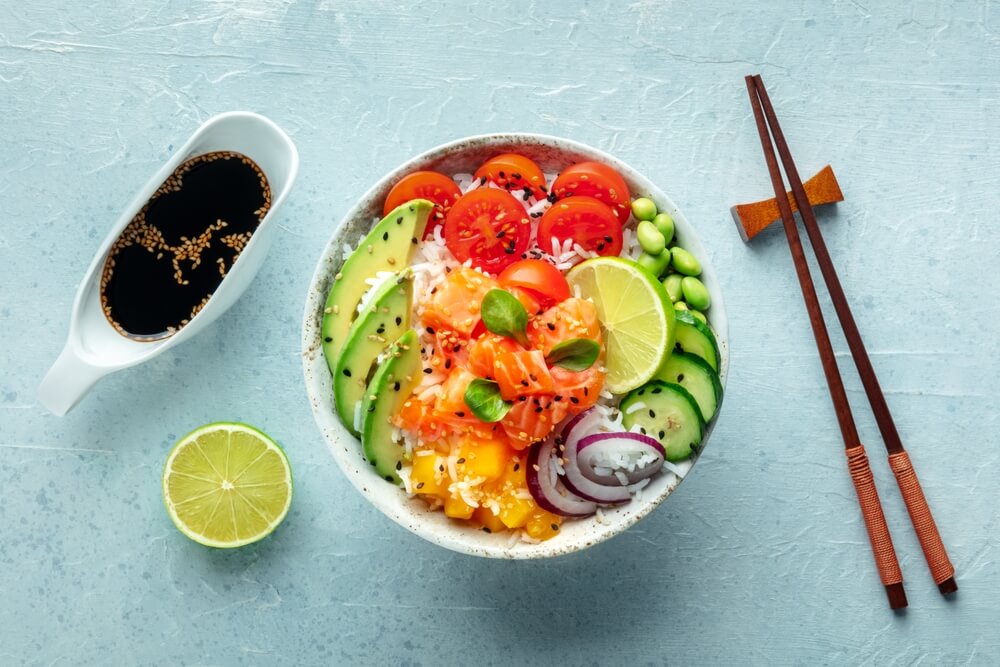
Poke bowl with salmon, edamame and mango
Edamame are an excellent ingredient for bowls. They provide plant-based protein, add a satisfying crunch and complement vegetables, rice or fish perfectly in terms of flavour. Combined with fresh ingredients, they make for a filling yet light meal.
Recipe for 4 people
Ingredients
For the bowl
- 400 g sushi rice (uncooked)
- 350 g fresh, sushi-grade
salmon - 250 g edamame, shelled (frozen or fresh)
- 1 avocado
- 1 mango
- 1 small cucumber
For the marinade
- 4 tablespoons soya
sauce - 2 teaspoons sesame oil
- 1 tablespoon lime
juice - 1 teaspoon maple
syrup
For the chilli mayo dip
- 3 tablespoons of mayonnaise
- 1 teaspoon Sriracha sauce
Optional
- light or dark sesame
seeds - spring onions
- Chilli flakes
- Coriander
Method
- Rinse the sushi rice thoroughly to remove any excess starch. Then cook it according to the instructions on the packet and leave it to cool slightly.
Mix 1½ tablespoons of rice vinegar with ½ tablespoon of sugar and ½ teaspoon of salt, then gently stir this marinade into the warm rice.
- Cook the shelled edamame in boiling water for about 3 minutes, drain them and leave them to drain well.
- Peel the mango and dice the flesh. Cut the cucumber into bite-sized pieces and the avocado into wedges.
- Cut the salmon into small, even cubes. Place it in a bowl and gently toss with the soya sauce, sesame oil, lime juice and maple syrup.
- For the dip, mix the mayonnaise with the Sriracha sauce until you have a creamy chilli mayonnaise.
- Divide the rice between four bowls. Top with the salmon, edamame, mango, avocado and cucumber. Drizzle a little chilli mayonnaise over the top, if desired.
- Sprinkle the bowls with sesame seeds, spring onions, coriander or chilli flakes to taste, and serve immediately.
Tip: Instead of sushi rice, you can also use basmati rice or quinoa.





