
What is eczema?
Eczema is an inflammation of the upper layer of the skin. This skin condition is not contagious and is often itchy. Typical symptoms include redness, flaking, blisters, oozing or scabbing. ‘Eczema’ is an umbrella term. It covers various forms of inflammatory skin conditions with similar symptoms. Eczema is often caused by direct contact with substances that irritate the skin or trigger an allergic reaction. These include, for example, soaps or disinfectants. It may also be caused by an allergic reaction to contact allergens such as nickel, fragrances and preservatives, rubber or certain plants. Almost everyone develops eczema at least once in their lifetime. The rash can be acute or chronic.
What causes eczema?
The causes of eczema depend on the type of eczema. Whilst contact eczema is triggered by skin-irritating substances, genetic predisposition often plays a role in atopic eczema (neurodermatitis). A distinction is made between exogenous and endogenous eczema.
- Exogenous eczema: Exogenous eczema is also known as contact eczema. It can arise either from an allergic reaction to a contact allergen or following irritation caused by a toxic or irritant substance.
- Allergic contact eczema: This occurs when the body overreacts to certain substances following sensitisation. These include both natural substances, such as plant constituents, and synthetic compounds, such as nickel sulphate, fragrance mixtures, skincare products or formaldehyde. Contact usually occurs directly via the skin; in rare cases, it can also occur through ingestion. Once developed, a contact allergy usually persists for life.
- Non-allergic (irritant) contact dermatitis: This is caused by contact with chemicals such as cleaning products.
- Endogenous eczema: Endogenous eczema is caused by a genetic predisposition. It affects around ten per cent of the population. The most common form of endogenous eczema is atopic dermatitis, better known as neurodermatitis.
Other triggers for eczema include, amongst others:
- emotional stress
- fluctuations in temperature or changes in humidity (dryness-induced eczema)
- Staphylococcus aureus bacteria on the skin
- certain airborne particles, e.g. house dust mites, mould and animal hair or dander
- certain skincare products, e.g. cosmetics, perfumes, harsh soaps
- Interaction between medication and UV radiation (phototoxic or photoallergic eczema)
- Sweating
- Contact with irritants, e.g. wool
- In some infants, food allergies can trigger eczema
How does contact eczema develop?
If the outermost layer of the skin is damaged by a toxic or allergenic substance, the body reacts by causing inflammation in the affected area of skin. The word ‘eczema’ comes from Greek and means something like ‘to swell’ or ‘to boil up’. Contact eczema usually develops in several successive stages:
- Stage 1: Following contact with the irritant, the skin becomes red, hot to the touch and intensely itchy. This redness is sharply defined.
- Stage 2: In the case of a mild reaction, the skin heals as the outermost layer of skin peels off. In more severe cases of eczema, the condition progresses to the blister stage. The blisters, which are about the size of a pinhead, are filled with clear fluid. The affected areas itch and sting. Many sufferers scratch these blisters open, causing the skin to weep.
- Stage 3: Once the blisters have burst, the affected area forms a scab. The itching subsides after a few days, and the skin heals with the out-peeling of the outermost layer.
If the skin comes into repeated contact with the irritants, chronic eczema may develop. The skin in these areas is dry and itches constantly. 
What symptoms can occur?
What eczema looks like, where on the body it occurs and whether it is associated with other symptoms depends on the type of eczema. Overview of typical symptoms
Seborrhoeic eczema
Symptoms may include greasy, sharply defined, scaly patches of skin, which do not usually itch. They mostly appear on areas of skin with many sebaceous glands. These are found, for example, on the scalp and face.
Atopic dermatitis
Atopic dermatitis is a chronic skin condition that occurs in flare-ups. The following symptoms may occur:
- dry, reddened skin lesions, often with indistinct borders
- severe itching
- Infants: a rash on the cheeks and on the extensor surfaces of the arms and legs
- Children/adolescents/adults: eczema in the skin folds (particularly behind the knees and in the crooks of the elbows), frequently also on the hands, throat and nape of the neck
- crusted areas of skin caused by scratching or weeping

Non-allergic (irritant) contact eczema
Contact dermatitis can present in a wide variety of ways. The symptoms and appearance depend heavily on the substance that caused the condition. In most cases, symptoms only occur on areas of skin that have come into contact with the irritant.
Chronic irritant contact dermatitis
With repeated or prolonged contact with the irritant, the eczema does not clear up and becomes chronic. It is characterised by dry, flaky skin, increased thickening of the skin and itching. The skin thickens, becomes cracked and rough. Different stages of eczema may co-exist.
Allergic contact dermatitis
This spreads outwards from the site of contact and causes itching (spread reaction).
How is eczema diagnosed?
Diagnosing eczema requires a thorough examination of the skin and a discussion of the patient’s medical history. This also includes assessing any possible family history of the condition. The diagnosis is made by a dermatologist or GP through an analysis of the skin’s appearance or the inflamed area of skin. Redness, possibly accompanied by weeping blisters, is usually a clear sign of eczema. To confirm the diagnosis, it is also important to identify what triggered the skin reaction. Those affected should therefore describe as precisely as possible which substances they have previously come into contact with and whether the rash is a recurring condition. If atopic dermatitis or an allergic reaction is suspected, an allergy test and a blood test will be arranged.
Patch test
If an allergic reaction is suspected, a so-called patch test is carried out. This involves applying the substances to be tested to the back, where there is no rash, and covering them with a film:
- After 48 hours, the film is removed and the test is read for the first time.
- After 72 hours, the skin is examined a second time and the result is discussed.
The test indicates whether a patient is sensitised to one or more substances. If contact sensitisation is present, an eczema-like reaction develops at the site of contact. 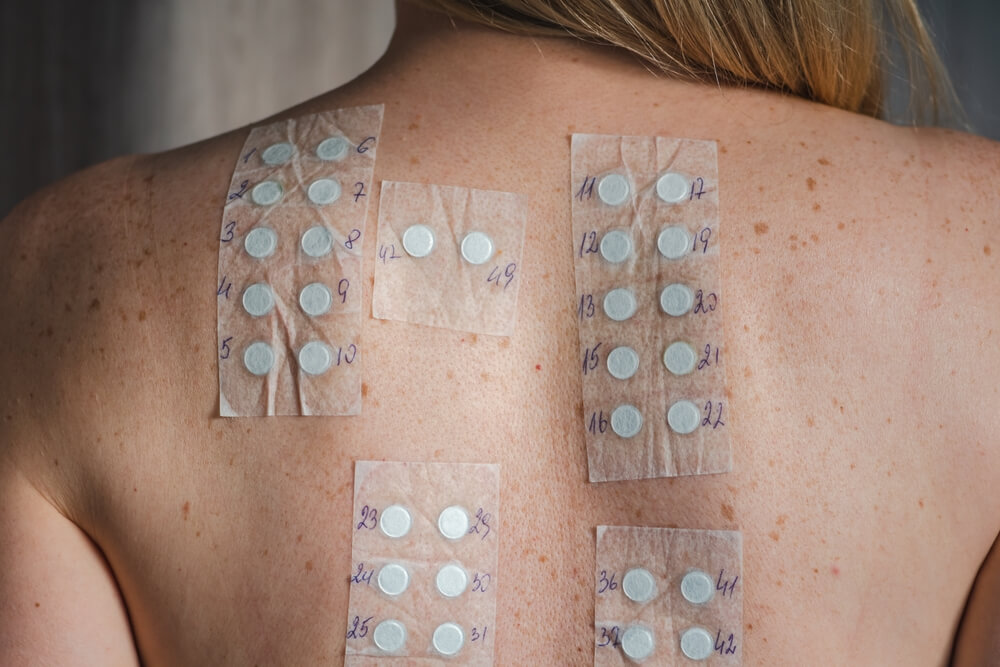
How is eczema treated?
The most important measure is to avoid contact with the triggering substance. If the allergen or irritant cannot be completely removed from the patient’s environment, measures should be taken to prevent further contact. These include:
- protective clothing (e.g. protective gloves when handling skin-irritating substances)
- appropriate skin care
- occupational hygiene measures, such as changing work processes or avoiding wet work
- In the case of contact allergies caused by food, a change in diet may be helpful; for example, a low-nickel diet for a nickel allergy
Local treatment
In most cases, local treatment is sufficient to manage the symptoms. Ointments containing corticosteroids and calcineurin antagonists are used to relieve inflammation and itching. In cases of chronic eczema, particularly on the hands, UV radiation or PUVA therapy – which combines natural plant-based substances (psoralens) with UVA light – can also be effective. In some cases, psoralen is also applied topically to the skin.
Systemic treatment
In cases of severe acute contact dermatitis, short-term oral corticosteroids may be necessary. In certain cases, ciclosporin A or alitretinoin are also used. Desensitisation therapy, as used for pollen or insect venom allergies, is not available for the treatment of allergic contact dermatitis. It is therefore not possible to gradually accustom the immune system to an allergen.
Skin care and protection
It is important to follow up with moisturising skincare products. This accelerates the regeneration of the skin barrier and helps prevent the recurrence of eczema. The use of skin protection products is also advisable. These should be tailored to the individual needs of the person affected. To relieve the itching associated with contact eczema and speed up healing, a mild anti-inflammatory cortisone ointment may also help. Acute flare-ups of atopic dermatitis are treated with cortisone-based and other anti-inflammatory ointments.
Who treats eczema?
Eczema is examined and treated by dermatologists. However, general practitioners are usually familiar with the various forms of eczema and can make an initial diagnosis. Dermatologists are generally responsible for the treatment itself and for determining the cause.





