Summary
Antibiotic resistance
Definition: The development of bacterial resistance to antibiotics
Causes: Genetic mutation, gene transfer in bacteria; accelerated development due to the widespread and inappropriate use of antibiotics
Types: natural and acquired
Consequences and risks: prolonged treatment duration, increased risk of death, limited treatment options, spread of resistance
Countermeasures: responsible use of antibiotics in humans and animals; monitoring and data collection; development of new antibiotics and therapies; improved hygiene; education and public awareness; international cooperation
What are antibiotics?
Antibiotics are life-saving medicines used to treat bacterial infections. They work by attacking bacteria – for example, by destroying the cell wall or blocking their reproduction. Penicillin was the first antibiotic, and many more have been developed since then.
Important: Antibiotics are only effective against bacterial infections. They have no effect on viral illnesses such as the common cold or flu. You can read more about antibiotics here.
What does antibiotic resistance mean?
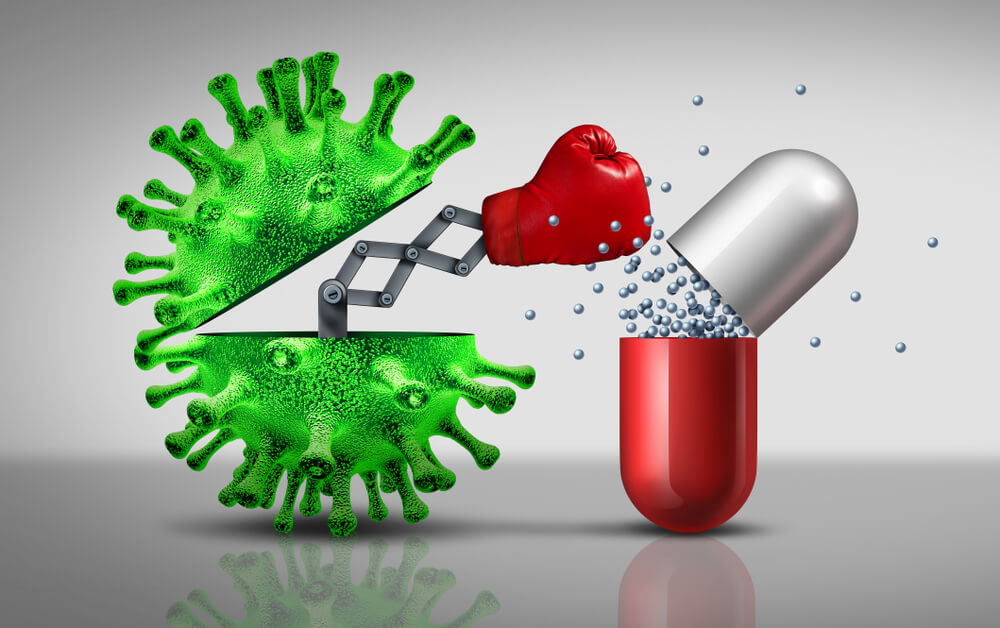
Antibiotic resistance means that bacteria have developed a resistance to antibiotics. Medicines that normally kill bacteria or inhibit their growth no longer work, or only have a limited effect, against resistant bacteria.
Humans have contributed significantly to this development, as antibiotics are often overused or misused. Both of these factors increase the risk of resistant bacteria emerging and spreading.
How does resistance develop?
The ability of bacteria to resist antibiotics is a natural phenomenon. Various mechanisms are involved, including:
- Genetic mutation: Changes in the genetic material can occur as bacteria multiply. As a result, some bacteria develop new strategies that make them insensitive (resistant) to certain antibiotics.
- Gene transfer: Bacteria can exchange resistance genes amongst themselves – much like we share information. This enables them to rapidly develop resistance to new medicines.
These processes are accelerated by the widespread use or incorrect application of antibiotics in humans and animals.
What types of antibiotic resistance are there?
Experts distinguish between natural (primary) resistance and acquired (secondary) resistance:
- Natural resistance: Some bacteria are naturally resistant to certain antibiotics.
- Acquired resistance: This refers to a bacterium becoming resistant to an antibiotic to which it did not originally have any natural resistance. This occurs through the mechanisms of resistance development described above and can also lead to multidrug resistance.
What are the risks associated with antibiotic resistance?
When bacteria become resistant to antibiotics, even simple infections can become life-threatening. The following groups are particularly at risk:
- People with weakened immune systems
- Children and older people
- Organ transplant recipients
- Cancer patients undergoing chemotherapy
- People with diabetes
- Patients before or after surgical procedures
The main risks of antibiotic resistance:
- Prolonged treatment duration: Infections caused by resistant bacteria take longer to treat and are more difficult to manage.
- Increased risk of death: Multidrug-resistant bacteria can cause serious complications and increase the risk of death.
- Limited treatment options: As resistance increases, fewer and fewer effective medicines are available.
- Spread of resistance: Resistant bacteria can easily be transmitted from person to person or from animals to humans.
Why is antibiotic resistance on the rise?
The excessive use of antibiotics in medicine and agriculture encourages the proliferation of resistant bacteria. These are extremely adaptable and can mutate in such a way that antibiotics lose their effectiveness, whilst the bacteria continue to spread and pass on their resistance genes to other bacteria.
We now know that resistant bacteria can also be transmitted to humans through contact with animals or via food of animal origin.
What is being done to tackle antibiotic resistance?
Antibiotic resistance is one of the greatest health challenges of our time. To combat it, individual, national and global measures are needed, including:
- Responsible use of antibiotics: To this end, guidelines are being developed and implemented in human and veterinary medicine to prevent inappropriate use.
- Monitoring and data collection: To track developments, data on the prevalence of resistant bacteria and antibiotic consumption is continuously collected.
- Development of new antibiotics and therapies: Researchers are working to develop new active substances and alternative treatment methods to bridge the gap caused by resistant bacteria.
- Improved hygiene: Strict hygiene measures in hospitals and other facilities are designed to prevent the spread of infections and reduce the risk of resistance.
- Education and awareness-raising: The public is informed about the importance of antibiotics and the risks of resistance in order to promote responsible behaviour.
- International cooperation: Countries are exchanging information and best practice to develop joint strategies against resistance.
How can I help prevent antibiotic resistance?
As an individual, you cannot completely prevent antibiotic resistance, but you can help to counteract its development by:
- Taking antibiotics only for bacterial infections
- taking prescribed antibiotics exactly as directed by your doctor
- practising good hygiene to reduce the risk of infection
- getting vaccinated regularly to prevent infections
- choosing meat from sustainable livestock farming
What should you bear in mind when using antibiotics?
- Only take antibiotics if prescribed by a doctor.
- Do not stop taking them early, even if you are already feeling better. This is the only way to ensure that all pathogens are killed off.
- Stick strictly to the prescribed dosage and timing.
- Tell your doctor about any other medicines you are taking to avoid possible interactions.
- Be aware of any possible side effects and contact your doctor if they occur.
- Store antibiotics in accordance with the instructions on the package leaflet.
FAQ
The term ‘multidrug-resistant pathogens’ is used to describe bacteria that have developed resistance to several antibiotics. Multidrug-resistant pathogens are becoming an increasingly common problem, particularly in hospitals.
Antibiotic resistance is so dangerous because it significantly limits our ability to fight bacterial infections. When antibiotics fail, even simple infections can become life-threatening illnesses.
Antibiotic resistance is a complex problem influenced by many factors, and one that will not simply disappear. To slow down the development and spread of resistance, we can use antibiotics responsibly, observe good hygiene practices and get vaccinated regularly. Research also has a key role to play in finding new treatment options.
According to the World Health Organisation (WHO), around 1.3 million people worldwide died directly from infections caused by antibiotic-resistant bacteria in 2019. The WHO estimates that by 2050, antibiotic resistance could cause up to ten million deaths.


Kreft I et al: Antibiotic Handbook 2024|25. MWV Verlag, Berlin, 2024
Federal Ministry of Social Affairs, Health, Care and Consumer Protection (BMSGPK): National Action Plan on Antibiotic Resistance, Vienna 2023.
https://www.sozialministerium.at/Themen/Gesundheit/Antimikrobielle-Resistenzen.html, accessed January 2025
https://www.gesundheit.gv.at/gesundheitsleistungen/medikamente/antibiotikaresistenz.html, accessed January 2025
https://aerztezeitung.at/wp-content/uploads/2019/09/State_Antibiotikaresistenzen.pdf, accessed January 2025
https://www.rki.de/DE/Content/Infekt/Antibiotikaresistenz/Grundwissen/Grundwissen_inhalt.html, accessed January 2025