Summary
Allergy tests
Types: skin tests (prick test, intradermal test, epicutaneous test, scratch test, friction test); blood tests; provocation tests
When carried out: at any time, regardless of the season
Risks: in very rare cases, severe allergic reactions, including anaphylactic shock
Which doctor: Doctors with additional qualifications in allergology, allergy clinics
What is an allergy and how does the body react to it?
An allergy is an exaggerated, specific defence reaction by the body to substances that are actually harmless but foreign to the body, such as certain foods, house dust mites or plant pollen. The following happens within the body: Upon first contact with such an allergen, the immune system produces so-called IgE antibodies to defend against the allergen; and when one comes into contact with this protein again, messenger substances such as histamine are released, which then, in combination with other substances in the body, trigger symptoms such as itching, a runny nose or a cough. Sometimes, an allergic reaction can also be triggered by T-lymphocytes without the involvement of antibodies.
Allergic reactions frequently occur on the skin and mucous membranes, in the airways or in the mouth and throat. Symptoms often appear immediately, but sometimes only after several hours or days. We now know that genetic predisposition, environmental factors and lifestyle play a decisive role in the development of allergies.
What is an allergy test?
An allergy test is a medical procedure used to determine which substances (allergens) a person is hypersensitive to. During this test, the person concerned is exposed to potential allergy triggers. The physical reaction provides information on whether hypersensitivity exists and, if so, to which allergens.
Why is an allergy test needed, and when is it advisable?
Allergies are now among the most common chronic conditions and are often accompanied by severe symptoms. The danger with allergic conditions is that they can progress if no action is taken. For example, hay fever can develop into asthma. For this reason, if you experience typical symptoms (e.g. recurrent colds, recurrent conjunctivitis, skin reactions), you should consult a doctor, who, following a thorough medical history and examination, can determine which allergy test is appropriate for you.
When is an allergy test carried out?
An allergy test can be carried out at any time of year; this means, for example, that if a pollen allergy is suspected, testing can be done regardless of the season. There is no minimum age for allergy tests; even babies can be tested if an allergy is suspected. This is important so that appropriate treatment can be started as early as possible.
What types of allergy tests are available?
There are various testing options available to diagnose an allergy. These include:
- Skin tests: Skin tests are the most commonly used and include the prick test, the intradermal test, the epicutaneous test (also known as a patch test), the scratch test and the rub test. In these tests, an allergic reaction is triggered by introducing a dose of allergen onto or into the skin.
- Blood tests: Blood tests are often carried out as a supplementary measure. They involve measuring immunoglobulin E (IgE) levels, which are frequently elevated in people with allergies.
- Provocation tests: These are used as confirmatory tests, particularly in unclear cases of respiratory, food or drug allergies. Provocation tests serve to confirm a suspected allergy. There are different types of provocation tests, such as nasal, inhalation, conjunctival or food provocation tests.
Skin tests: What happens during a skin test?
Skin tests are the most important diagnostic tool for identifying an allergy, after the medical history. They can be carried out quickly, are generally sufficiently reliable and have a low complication rate. During the test, a dose of allergen is applied to or injected into the skin to trigger an allergic reaction, if present.
Prick test
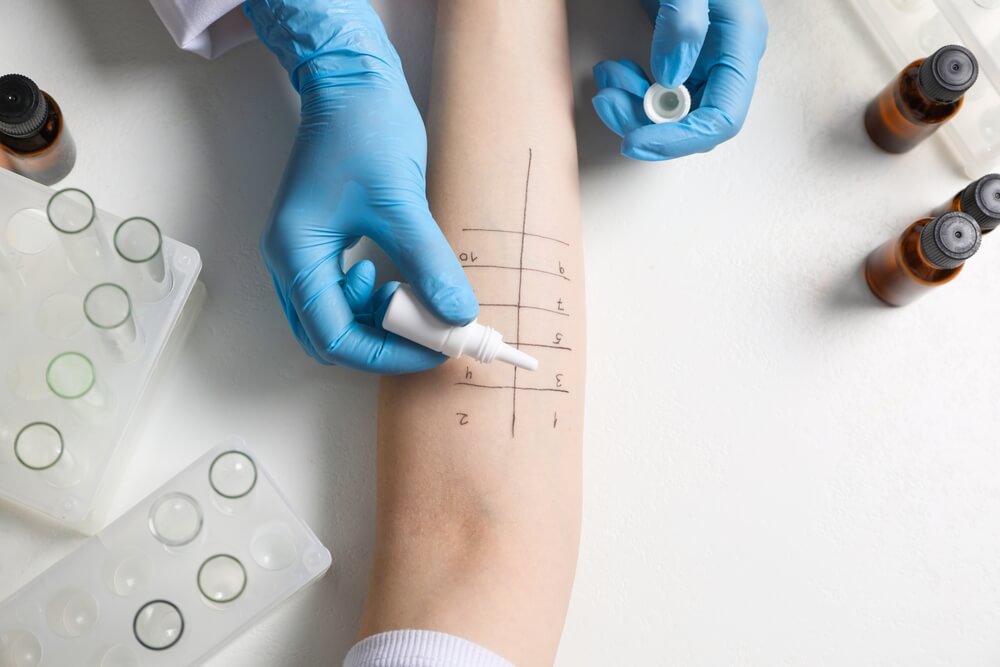
The prick test is a standard test for immediate-type allergies such as pollen, house dust and animal hair allergies. In this test, a pipette is used to place a drop of an allergen-containing solution onto marked areas of the skin, which is then carefully introduced into the skin using a disposable lancet or pricking needle. This allows the allergen-containing solution to enter the body, and if a skin reaction then occurs, the test is positive.
The prick test is very commonly used and carries a low risk. With allergy tests, severe reactions may occasionally occur at the tested skin site. Although rare, there is a risk of a severe anaphylactic reaction. Patients are therefore kept under medical observation for at least 30 minutes after the allergen has been administered.
Intradermal test
The intradermal test is also used to diagnose immediate-type allergies and works in a similar way to the prick test, but the allergen solution is injected intradermally – that is, into the skin – using a fine needle. A small wheal should then form. The test is considered positive if the wheal increases in size by three millimetres and if a local allergic reaction (itching, burning) occurs.
This procedure is the most sensitive of all skin tests; however, false-positive results occur more frequently than with the prick test. There is also a small risk of anaphylactic shock with the intradermal test, and the patient is therefore monitored.
Epicutaneous test (patch test)
The epicutaneous test is used to diagnose contact allergies of the skin. In this test, potential allergens are applied to the back using an adhesive strip in a base such as Vaseline.
The skin is examined for reactions after 24, 48 and 72 hours. If redness, itching or, for example, eczema occurs, the test is positive. The risks associated with this test are low, and a severe anaphylactic reaction – which is dangerous – occurs only very rarely.
Scratch test
This test is used, for example, when high sensitisation is suspected. The allergen extracts to be tested, histamine and a control solution are applied to the skin, and the skin is scratched through the droplet. The scratch test is considered positive if redness and wheals appear within 20 minutes. However, the scratch test can cause general skin irritation, which makes it difficult to interpret the result. This is also one reason why this test is hardly ever carried out nowadays.
Rub test
This test is also used when high sensitisation is suspected. The test material containing the allergen is rubbed back and forth on the inside of the forearm. The result is assessed after 20 minutes.
Blood test: What happens during a blood test?
Blood tests to diagnose an allergy can be used either as an alternative to or in addition to skin tests. All that is required is a blood sample. The analysis is carried out in the laboratory, where the immunoglobulin E (IgE) level in particular is measured. An elevated IgE level may be an indication of an allergy. Furthermore, the laboratory results make it possible to identify the specific allergens that may be responsible for the individual’s symptoms.
Provocation test: What happens during a provocation test?
In challenge tests, patients suspected of having an allergy are deliberately exposed to potential allergens. These tests are used particularly when previous investigations have been inconclusive or contradictory. A distinction is made between nasal, conjunctival, bronchial and oral provocation tests. The nasal provocation test is the most commonly used, particularly for diagnosing suspected allergic rhinitis. In this test, a solution containing the suspected allergen is instilled into the nose. If symptoms such as a runny nose or swelling of the nasal mucosa occur as a result, the test is considered positive. However, provocation tests can trigger severe allergic reactions, so they should only be carried out in specialist facilities.
What should be borne in mind with children?
Allergies often develop very early in life, and experts agree that, where there is reasonable suspicion, even babies can be tested for allergies. The tests are no different from those carried out on adults. However, children should not be exposed to a whole series of tests, but only to individual allergens, and it is recommended that patch tests should only be carried out from the age of six.
Which doctors carry out allergy tests?
Allergy tests are usually carried out by doctors with additional qualifications in allergology. These are mostly dermatologists, ENT specialists, respiratory specialists, paediatricians and, sometimes, general practitioners.
What are the risks associated with allergy tests?
In very rare cases, an allergy test can trigger a severe allergic reaction, such as anaphylactic shock. It is therefore extremely important that these tests are always carried out under controlled conditions.
FAQ
Experts emphasise that an allergy can only be diagnosed using scientifically validated tests. Furthermore, when diagnosing allergies, it is very important for the doctor to carry out a detailed medical history and physical examination before testing, as it is only by considering these factors together that a meaningful conclusion can be reached.
Allergy tests can be carried out at allergy clinics or by specialists with additional qualifications in allergology.
The time taken to obtain the results of an allergy test depends on the specific test method used. For example, a prick test can be assessed after 15 to 20 minutes, whilst it can take up to three days to receive the results of a patch test.
Different health insurance providers have different policies on covering allergy tests. You should check with your health insurance provider or the doctor carrying out the test.


Klimek L et al: White Paper on Allergies in Germany. Springer Medizin Verlag, 4th edition, 2019
https://www.ecarf.org/info-portal/allgemeine-allergie-infos/allergie-tests-im-ueberblick/, accessed March 2024
https://www.aha.ch/allergiezentrum-schweiz/allergien-intoleranzen/wissenswertes/allergietests, accessed March 2024
https://allergiecheck.de/pages/allergietest, accessed March 2024
https://www.gesundheit.gv.at/krankheiten/allergie/kinder.html, accessed March 2024
https://www.lungenaerzte-im-netz.de/krankheiten/allergien-allgemein/untersuchung/, accessed March 2024