Summary
Measles: A highly contagious disease that must be reported. It is most commonly seen in children, but teenagers and adults can also contract it.
Causative agent: Measles virus
Transmission: Through coughing, sneezing or direct contact with saliva
Symptoms: Fever, a runny nose, a sore throat, a dry cough, tiredness, digestive problems, red eyes, measles rash
Diagnosis: Consultation with a doctor, physical examination, blood test
Treatment: Plenty of rest, bed rest, drinking plenty of fluids
Prevention:
Vaccination
In this article, you will find lots of important information about measles, explained in simple language. This text contains general information and is not a substitute for a visit to a doctor.
What is measles?
Measles is a highly contagious disease. It is caused by a virus. If someone has measles, they can easily pass the virus on to other people. Many people think that only children get measles, but teenagers and adults can also catch it. Measles is often not very serious. However, the illness can be more severe in young children and adults.
How do you catch measles?
Measles spreads through the air. When someone with measles coughs or sneezes, tiny droplets containing the virus are released into the air. Other people can breathe in these droplets and catch measles. This is also known as droplet transmission. However, you can also catch it by, for example, using the same cutlery or crockery.
Who gets measles?
Anyone who hasn’t been vaccinated can catch measles. This includes adults. That’s why getting vaccinated against measles is very important.
How do you know if you have measles?
The first signs of measles are:
- Fever
- A runny nose
- Cough
- Red eyes and sensitivity to light
- Constipation or diarrhoea
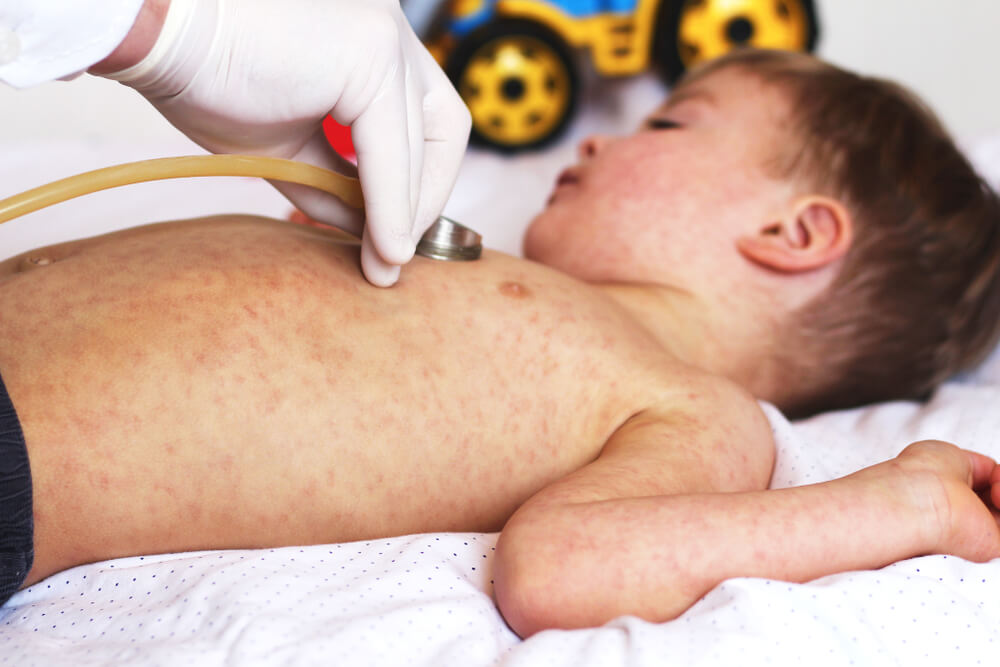
After a few days (3 to 7), red spots appear on the skin. These spots usually start on the face and then spread across the whole body.
Important: If measles is suspected, the doctor must be informed in advance by telephone.
What are the possible consequences of measles?
Measles is not a harmless illness. Most people recover fully after having measles. However, serious complications can sometimes occur. Measles puts a strain on the body and weakens it. This makes it easier to catch other illnesses.
Other possible illnesses include:
- The lungs can become affected: pneumonia can be a complication.
- Middle ear infection: very severe earache
- Severe diarrhoea
- Encephalitis: Encephalitis is an inflammation of the brain. This can have serious consequences.
- Subacute sclerosing panencephalitis (SSPE): A very rare and dangerous disease. It can occur even many years after having had measles. Babies are particularly at risk.
- Pregnancy: If a pregnant woman contracts measles, this can lead to premature births or miscarriages.
How is measles treated?
There is no specific medicine for measles. Treatment for measles is therefore symptomatic, meaning that the symptoms are treated.
It is important to:
- Bed rest: Stay in bed and get plenty of rest
- Drink plenty of fluids: Drink plenty of fluids, such as water or tea
- Eat light, easily digestible meals
- A well-ventilated room: A room with fresh air and, if necessary, it should be kept dark.
- Fever and cough: Medicines for fever and cough can be taken after consulting a doctor.
Severe cases:
- Hospital: In the event of a serious illness, hospital treatment may be necessary.
- Bacterial infections: If you also develop a bacterial infection, such as an ear infection, your doctor may prescribe additional medication.
What can be done about measles?
The best thing is to get vaccinated. The measles vaccine provides very good protection against the disease. You need two doses of the vaccine to be fully protected.
Can you get measles more than once?
No, once you’ve had measles, you won’t get it again.
Why is the vaccination important?
Vaccination is important because measles can be a dangerous illness. Sometimes people develop serious complications from measles, such as pneumonia or encephalitis. Getting vaccinated protects both yourself and others.
FAQ
It is not only children but also adults who can catch measles. The disease is particularly dangerous for people who have not been vaccinated.
At first, symptoms appear just like those of a common cold – such as a fever, a cough, a runny nose or a sore throat. The fever subsides. Then red spots appear on the skin and the fever rises again.
The period between infection with the measles virus and the onset of the disease lasts around 7 days, or in rare cases up to 21 days.


Austrian Immunisation Schedule 2023/2024, Federal Ministry of Labour, Social Affairs, Health and Consumer Protection, https://www.sozialministerium.at/Themen/Gesundheit/Impfen/Impfplan-%C3%96sterreich.html, accessed 8 February 2024
Heininger U.; Measles Vaccination in Practice – Ten Important Questions and Answers on the MMR Vaccine, ARS Medici 1+2/2018, Rosenfluh Publikationen AG
Flick H. et al.; Pertussis and Measles on the Rise, Universum Innere Medizin 10/2015, MedMedia Verlag und Mediaservice GmbH
Wiedermann-Schmidt U. et al.; Measles, Pertussis, Pneumococci, HPV: Using patient consultations to provide information, Universum Innere Medizin 01/2014, MedMedia Verlag und Mediaservice GmbH
Measles, RKI Guide, Robert Koch Institute, URL: https://www.rki.de/DE/Content/Infekt/EpidBull/Merkblaetter/Ratgeber_Masern.html, last accessed: 08.02.2024
WHO: Measles, global situation, https://www.who.int/news-room/fact-sheets/detail/measles, accessed: 8 February 2024
Measles: current situation in Austria: https://www.ages.at/mensch/krankheit/krankheitserreger-von-a-bis-z/masern, 8 February 2024
Austrian Ministry of Social Affairs, https://www.sozialministerium.at/Themen/Gesundheit/Uebertragbare-Krankheiten/Infektionskrankheiten-A-Z/Masern.html. 8 February 2024