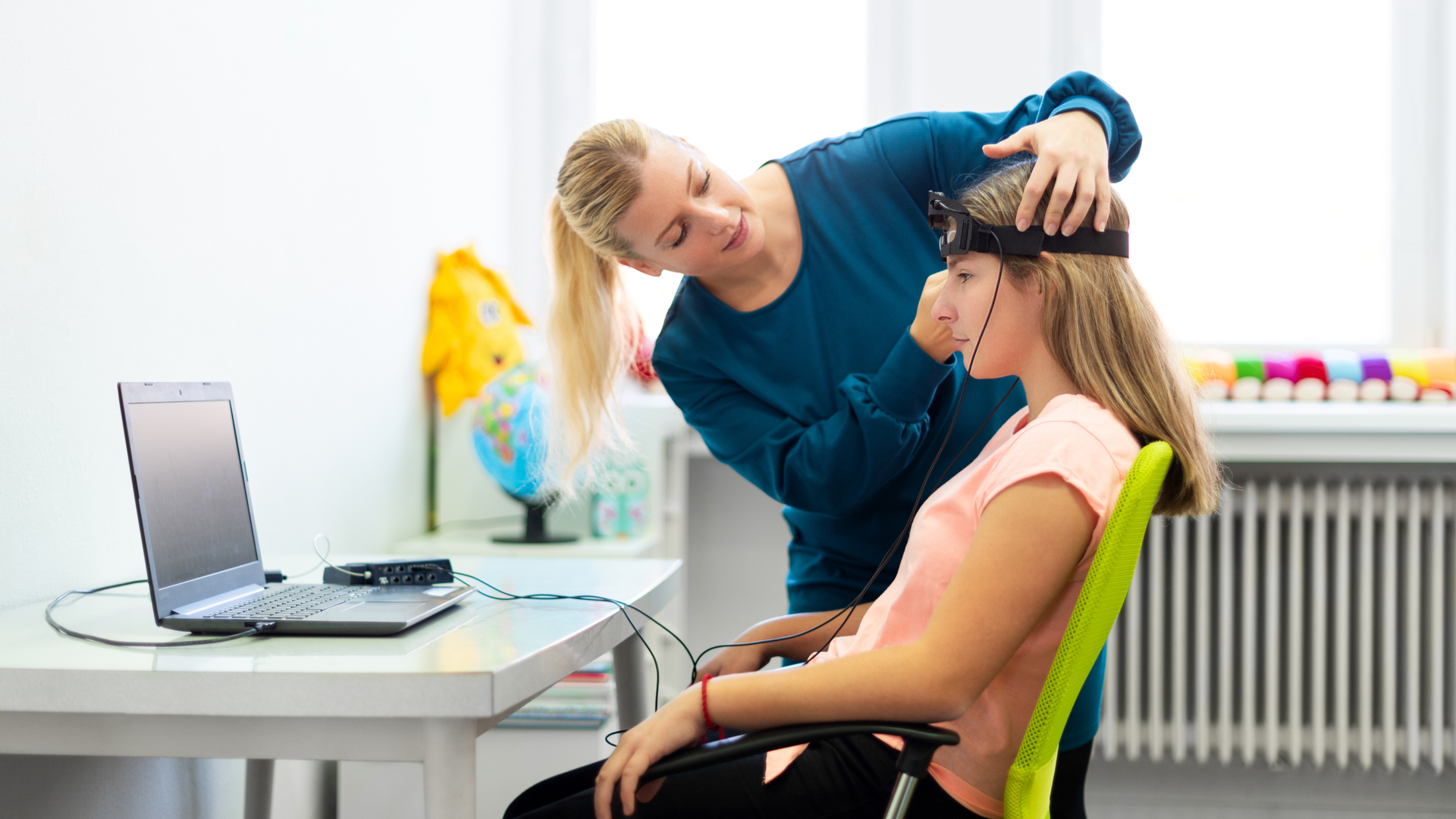
What is neurofeedback?
Neurofeedback is a computer-assisted form of behavioural therapy and a proven method of digital mental training, which uses feedback to make unconscious neurophysiological processes perceptible. Feedback is the basis of all learning. Our brain always responds to stimuli in a solution-oriented way and, in doing so, learns which responses are best suited to dealing with those stimuli.
How does neurofeedback work?
To measure brain activity, EEG electrodes are attached to the patient’s head and the measurement data is transmitted to a computer. The EEG is analysed in real time and broken down into its frequency components. In parallel with the measurement, the computer calculates audiovisual feedback from the EEG signals. This feedback signal is linked to a computer-controlled reward system based on operant conditioning and is displayed to patients on a separate screen. The patient’s brain begins to react immediately to the feedback signals, thereby altering its activity. These changes are recorded by the EEG electrodes and immediately fed back via signal processing. This creates a continuous cycle to which the brain constantly adapts. The therapeutic effect is controlled by the choice of electrode positions and the settings of the feedback software. Through this feedback training, the brain learns to optimise its ability to self-regulate. This leads to an improvement in symptoms associated with dysregulation. These experiences of success motivate the brain to achieve the newly learnt self-regulatory processes ever more quickly and sustainably, and to transfer them into everyday life.
What is the therapeutic process for neurofeedback?
Neurofeedback therapy begins with a detailed consultation and a medical and/or therapeutic history taken by a specialist. Sometimes, additional diagnostic tests are advisable. This is usually the case when there is an attention and impulse control disorder. Another key point of discussion is setting personal therapy goals and identifying the patient’s potential for development. You should allow one and a half to two hours for the initial appointment. Subsequent therapy sessions last between 30 and 60 minutes each, depending on the neurofeedback method and the patient’s age. Regular assessments may take place during therapy to compare the results achieved with the baseline values and the set goals. To allow the brain to adapt, therapy usually begins with a frequent session schedule of two to three sessions per week. The intervals are then gradually increased. Once the skills have been successfully transferred to everyday life, the therapy can be concluded. It usually takes between 20 and 40 sessions to reach the target; for some conditions, more may be required.
What are the areas of application for neurofeedback?
Neurofeedback trains specific brain functions such as concentration, relaxation, stamina, peak performance, creativity and memory. It is a highly effective rehabilitation method for stress-related conditions and functional disorders. The treatment is also used successfully to enhance mental performance (peak performance) in sport, work and school, as well as to promote creativity and in workplace health promotion. Through neurofeedback, the brain learns to increase those brain waves that are needed in greater quantities for, for example, relaxed attention, creativity or peak performance, and to reduce those brain waves that trigger anxiety, depression and feelings of stress. As neurofeedback can be used to specifically train the activity and self-regulatory capacity of the central nervous system, its potential applications are correspondingly diverse.
How does neurofeedback help with ADHD?
ADHD is an attention deficit and hyperactivity disorder that manifests itself in behavioural problems. The main cause is thought to be a central regulatory disorder in the brain, as well as impaired information processing between the various neural networks. This is because there is a direct link between activity patterns in the brain and the behaviour of those affected. Neurofeedback can address the root cause of the condition directly. Through neurofeedback, patients learn to self-regulate their own brain activity in a targeted manner, enabling them to positively influence their symptoms and thus better cope with the challenges of everyday life. The therapy is now recommended by the American Paediatric Society as an evidence-based treatment method for ADHD. In Germany, neurofeedback is listed in the S3 guideline for the treatment of ADHD. The Austrian Ministry of Health also mentions neurofeedback as a treatment option in its 2013 ADHD report.
How does neurofeedback help with autism?
Autism spectrum disorders (ASD) are profound developmental disorders involving changes in neural and psychological development. Children with an ASD may also develop mental health conditions such as anxiety disorders, attention-deficit/hyperactivity disorder (ADHD) or depression. People with autism are at a higher risk of developing mental health conditions, which in turn can exacerbate autism-specific symptoms. Treatment of comorbid mental health disorders using behavioural therapy methods (e.g. occupational therapy, neurofeedback, etc.) and, where appropriate, in combination with medication, is therefore recommended. This enables affected children to learn to control their behaviour more effectively and thus cope more easily with their condition. Initial studies show that neurofeedback can be successfully used to treat disruptive symptoms such as repetitive behaviours, social isolation and speech development deficits, and that children with ASD are generally able to learn this technique. In particular, there are signs of success in cases involving co-occurring ADHD symptoms, although a diagnosis in line with clinical guidelines should form the basis for treatment.
How does neurofeedback help in Long COVID therapy?
Alongside research into acute COVID-19, attention is now also turning to the medium- and long-term consequences of the infection. There is growing evidence that some people, even after recovering from the acute phase of the illness – including cases with few symptoms – must expect to continue experiencing physical and psychological impairments for some time. In this context, neurofeedback could help to alleviate neurocognitive and psychiatric symptoms such as attention and concentration difficulties, depression and anxiety, as well as pain. Even when used in combination with existing medication, this therapy may represent a useful addition to the treatment of Long COVID, although scientifically proven evidence on this is still pending.
Neurofeedback as mental performance training
Athletes, artists and students also suffer from stress-related illnesses, mental health conditions or unwanted behavioural patterns that can be attributed to dysregulation of brain activity. Neurofeedback can be used to enhance personal peak performance, enabling individuals to access resources such as maximum concentration, inner calm and absolute self-confidence when needed. It improves perception and prolongs periods of concentration. In addition to enhanced mental performance, this can also lead to greater self-esteem. This helps to promote optimal performance even under competitive and stressful conditions.
How does neurofeedback help with workplace health promotion?
In workplace health promotion, the focus is on stress tolerance, concentration and memory, as well as burnout prevention. Neurofeedback helps to increase stress tolerance, improves perception and extends periods of concentration. In addition to improved mental performance, this can also contribute to increased self-esteem and a greater zest for life. Guest article by Dr Michaela Gleußner, Neurology & Psychiatry, Neurofeedback Therapy
FAQ
Some examples of potential areas of application for neurofeedback include: ADHD, long Covid, autism, migraine, epilepsy, burnout, sleep disorders and chronic pain.
Unfortunately, neurofeedback sessions are not covered by statutory health insurance. Some private supplementary insurance policies cover part of the treatment costs; the amount covered depends on the specific policy.
No, in neurofeedback, patients are not given electric shocks; the electrodes are stuck to the skin and measure brain activity, and do not cause any pain.
Biofeedback measures and influences physical functions such as muscle tension and breathing. Neurofeedback is a specific form of biofeedback that focuses on monitoring and influencing brain activity.


Interdisciplinary, evidence- and consensus-based (S3) guideline ‘Attention-Deficit/Hyperactivity Disorder (ADHD) in childhood, adolescence and adulthood’, AWMF registration number 028-045, awmf online, 6/2018
Flatz, T., Gleußner, M., ‘The Brain Trains Itself – Neurofeedback Explained Simply’, NWV Neuer wissenschaftlicher Verlag, Vienna/Graz 2017
Prinz W., Neurofeedback as a Specialised Therapy Option, Psychopraxis-Neuropraxis, Springer, 5/2015
Flatz, T., Gleussner, M., ‘Neurofeedback for ADHD and Autism’, Paediatrics and Paedology, Springer, 1/2014
Rendi-Wagner P., Arrouas M., ADHD – Attention Deficit/Hyperactivity Disorder Report, Federal Ministry of Health, Vienna, 6/2013
Haus K.M. et al, Practical Guide to Biofeedback and Neurofeedback, Springer 2013
https://www.neurofeedback-institut.at/indikation, accessed: May 2024
https://neurofeedback-netzwerk.org, accessed: May 2024