Summary
Sore throat
Definition: Pain in the throat or pharynx: This can occur suddenly, persist for a prolonged period, be mild or severe, and feel in various ways (e.g. stabbing, pressing, pulling, burning, scratchy).
Causes: e.g. the common cold, a cold-like infection, flu, tonsillitis, laryngitis, bronchitis, rubella, measles, gastro-oesophageal reflux disease, infectious mononucleosis, tumours, foreign bodies, chemical burns and thermal burns, insect bites in the throat area, irritants such as nicotine, chemicals and dust
Diagnosis: Medical history, physical examination including inspection of the mouth and throat, palpation of the neck and lymph nodes, inspection of the skin, swab sampling, blood tests, and imaging procedures if necessary.
Treatment: Depending on the cause; including painkillers and anti-inflammatory medication, lozenges, gargles, herbal tea, and throat compresses
What is a sore throat?
A sore throat is pain, a scratchy sensation or a burning sensation in the throat and pharynx. It can vary in severity and feel different from person to person. Sore throats are very common and affect people of all ages. There are many different causes. In most cases, a sore throat is not a condition in its own right, but a symptom indicating an underlying illness or other triggers. It often occurs alongside other symptoms such as difficulty swallowing, a fever or hoarseness.
What causes a sore throat?
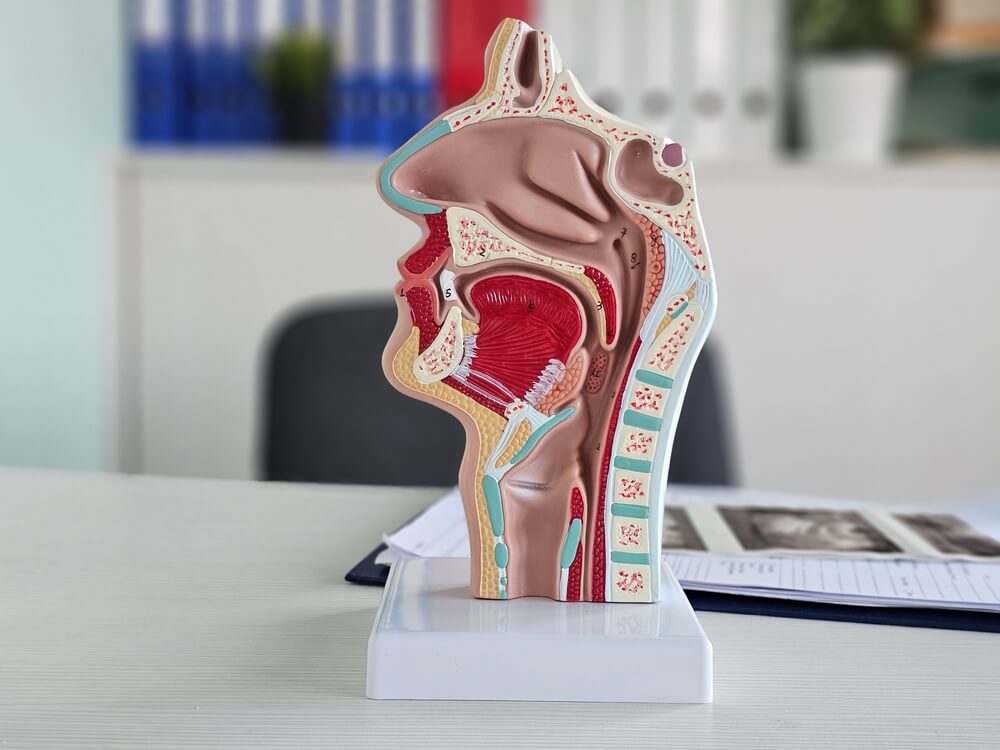
A sore throat usually develops when the mucous membranes in the throat and pharynx are irritated or inflamed. The throat contains several organs: the pharynx, the larynx, the oesophagus, the trachea and the thyroid gland. The pharynx is the section following the oral cavity and situated above the oesophagus. This is where the respiratory tract (from the nose and mouth to the lungs) and the digestive tract (from the oral cavity into the oesophagus) intersect. A distinction is made between various sections:
- Nasopharynx: upper part containing the pharyngeal tonsil
- Oropharynx: the middle section; the palatine tonsils are situated between the two palatal arches
- Laryngeal pharynx: lower part
The larynx consists of several interconnected cartilages (the laryngeal skeleton). The epiglottis plays an important role: when breathing, it is open and leaves the entrance to the larynx unobstructed. When swallowing, the epiglottis closes so that the bolus can slide backwards into the oesophagus. The so-called cricoid cartilage is situated in the lower part of the larynx. The trachea begins below this. The thyroid gland is also located just below the larynx. If inflammation or irritation occurs in any of these areas, pain may result. Possible causes include, for example:
- tonsillitis
- inflammation of the epiglottis
- heartburn or reflux, where stomach acid flows back into the oesophagus
However, the causes of a sore throat may also lie within the respiratory tract, for example in the case of bronchitis. The upper respiratory tract includes:
- the nose and sinuses
- The oral cavity and pharynx
The lower respiratory tract includes:
- Larynx
- Trachea
- Bronchi
Which infectious diseases cause a sore throat?
A sore throat can be caused by various conditions or external irritants. It is often caused by a viral infection of the respiratory tract.
Flu-like infections/colds
Flu-like infections and colds are the most common cause of a sore throat. Important: Flu-like infections and colds are not the same as actual flu! The term ‘cold’ is usually used to describe uncomplicated respiratory tract infections. They occur particularly often during the colder months and are a common reason for visiting the doctor. They are usually caused by viruses (e.g. rhinoviruses). In addition to a sore throat, the following symptoms are typical of a cold:
- a runny nose
- a cough
- hoarseness
- headache
Read here to find out how to treat a cold.
Flu (influenza)
The flu, also known as influenza, is an infectious disease that primarily affects the respiratory tract. It is caused by viruses from the family known as orthomyxoviruses. The pathogens are classified into types A, B and C. The seasonal influenza A and B viruses are of particular relevance to humans. Influenza viruses are highly contagious. Infection usually occurs via droplet transmission, although smear and contact transmission are also possible. In the case of droplet transmission, the pathogens are spread via tiny droplets of secretions released when speaking, coughing or sneezing.
What happens when someone is infected by the virus?
After infection, the viruses invade cells in the respiratory tract and multiply there. This damages the cells and triggers an inflammatory response. The period between infection and the onset of the first symptoms is known as the incubation period. With flu, this is usually one to two days. The illness often begins suddenly. Possible symptoms of genuine flu include, amongst others:
- high fever
- cough
- severe sore throat
- muscle aches and headaches
- general weakness
- Bouts of sweating
- Chills
- Runny nose
The symptoms are often similar to those of a severe cold, but are significantly more pronounced. The symptoms, the course of the illness and the duration of flu can vary greatly from person to person. You can read more about the difference between a cold, COVID-19 and the flu here. 
Bronchitis
Bronchitis is an inflammation of the bronchi – the airways in the lungs. Acute bronchitis is a common condition. It usually occurs following a viral infection and typically clears up within a few weeks. Other possible causes and risk factors for acute bronchitis include:
- Bacteria
- Irritants/environmental pollutants (e.g. high levels of particulate matter)
- Smoking
- certain underlying medical conditions
Typical symptoms include:
- Cough
- Cough reflex
- Pain when coughing
Depending on the course of the illness, additional symptoms may occur. These include:
- thick phlegm
- increased mucus production
- sore throat
- fever
- Headache and aching limbs
- abnormal breathing sounds
In chronic bronchitis, the airways (bronchi) are permanently inflamed. If, in addition to the inflammation, the airways are narrowed (airway obstruction), the condition is referred to as chronic obstructive pulmonary disease (COPD). The condition develops over several years. The most significant risk factor for COPD is smoking.
Rubella, measles and mumps
Rubella, measles and mumps can also be accompanied by symptoms in the throat and pharynx. These illnesses are caused by viruses and are usually transmitted via droplet infection, for example when speaking, coughing or sneezing. They are among the classic childhood illnesses, but can also affect teenagers and adults if they do not have adequate vaccination or immune protection.
Laryngitis
Laryngitis is an inflammation of the lining of the larynx. Here too, there are acute and chronic forms. Possible causes of acute laryngitis:
- as a result of an upper respiratory tract infection
- excessive strain on the voice
- dry or smoky indoor air promotes inflammation
Possible causes of chronic laryngitis:
- smoking
- excessive vocal strain
- Reflux
- Working in environments with high levels of dust
- restricted nasal breathing (e.g. due to a chronic cold or chronic sinusitis)
Typical symptoms of laryngitis:
- Hoarseness or loss of voice
- A dry sensation in the throat
- Sore throat
- Dry cough
- Compulsive throat-clearing
Bacterial throat infections
As well as viral infections, bacteria can also cause inflammation in the throat and pharynx. This often leads to severe sore throats, difficulty swallowing and a fever. One of the best-known bacterial conditions is tonsillitis, which can be caused by streptococci, amongst other things.
Tonsillitis (angina tonsillaris)
Tonsillitis is an inflammation of the palatine tonsils. The condition can be acute, chronic or recurrent. The acute form is usually caused by viruses (e.g. adenoviruses), whilst the chronic, recurrent form is often caused by bacteria (e.g. streptococci). Possible symptoms of tonsillitis include:
- Sore throat
- Difficulty swallowing
- Swollen, reddened palatine tonsils
- reddened back of the throat
- Tonsils coated with a whitish or yellowish film (pus)
- Cough
- Enlarged lymph nodes that can be felt
- Bad breath
- Fever
- Physical weakness
Other bacterial throat infections
As well as tonsillitis, other bacterial infections can also cause a sore throat. These include, for example, scarlet fever, an infectious disease caused by certain types of streptococci and commonly seen in children. Rarer conditions such as diphtheria can also be accompanied by severe sore throats and inflammation in the throat area. Bacterial throat infections are usually treated with antibiotics, depending on the pathogen and the severity of the condition.
Other causes of a sore throat
A sore throat is not always caused by an infection. Other conditions or external irritants can also irritate the mucous membranes in the throat and pharynx and cause discomfort. These include, for example, acid reflux, foreign bodies, injuries or irritants such as smoke or chemicals. In rare cases, more serious conditions may also be the cause of persistent sore throats.
Gastro-oesophageal reflux disease
Food we eat passes through the oesophagus into the stomach. Normally, specific ring-shaped muscles between the oesophagus and the stomach prevent the backflow of stomach contents into the oesophagus. In gastro-oesophageal reflux disease (GORD), this muscular closure mechanism between the oesophagus and the stomach does not function as it should. As a result, stomach acid and stomach contents flow back into the oesophagus. This acid reflux irritates the lining of the oesophagus and, over time, can lead to damage to the lining and further complications. Often, no cause for the malfunction can be identified. A warning sign of possible reflux disease is heartburn. Heartburn causes a burning sensation in the upper abdomen or an uncomfortable feeling behind the breastbone. Heartburn is caused by the backflow of stomach acid into the oesophagus and often occurs after very large meals. If you experience heartburn regularly, it could be a sign of reflux disease.
Other possible causes
As well as infections, other medical conditions or external factors can also cause a sore throat. Possible causes include, amongst others:
- Glandular fever
- Epiglottitis (inflammation of the epiglottis)
- Tumours
- Foreign bodies in the throat
- Chemical burns or scalds in the throat or oesophagus
- Insect bites in the throat area
- Irritants such as nicotine, chemicals or dust
What are the symptoms of a sore throat?
The duration and severity of a sore throat can vary greatly. A sore throat can occur suddenly, gradually get worse, or even recur regularly. They often clear up on their own, but sometimes persist for a longer period. A sore throat can be barely noticeable or particularly severe and agonising. It can also feel different, for example:
- stinging
- oppressive
- tugging
- burning
- scratchy
Depending on the cause, a sore throat may occur on its own or alongside other symptoms. These include:
- Hoarseness
- Cough
- Difficulty swallowing
- A dry throat
- A runny nose
- Fever
- Headache
- Aches and pains
The list of accompanying symptoms provided here is intended to give an overview and may be incomplete; furthermore, a symptom may be a sign of other conditions affecting the throat. If in doubt, you should always seek medical advice.
How is a sore throat diagnosed?
The first point of contact for a sore throat is your GP; for children, it is the paediatrician. They can then refer you to other specialists as required, such as specialists in ear, nose and throat (ENT) (ENT). A visit to the doctor is not always necessary for a sore throat. Often, the pain can be relieved with simple remedies and subsides after a few days.  However, it is advisable to see a doctor if:
- the pain is particularly severe
- the symptoms do not improve after a few days
- the pain gets worse
- the sore throat is accompanied by other symptoms. These include:
- loss of voice
- visibly reddened tonsils
- swollen lymph nodes
- Fever
- breathing difficulties
- other serious symptoms
In the following cases, you should seek medical attention immediately:
- if there are foreign objects in the throat
- in the event of scalding or chemical burns
- in the event of insect stings in the throat
In many cases, the cause of a sore throat can be determined simply through a consultation (medical history) and a physical examination. During the consultation, the doctor will ask about your medical history, any medication you are taking and the exact nature of your symptoms. Questions may include, for example:
- how long the sore throat has been present
- how severe it is
- how it feels (e.g. stabbing, aching, burning)
- whether it can be relieved by certain remedies
- whether there are any other symptoms
During the physical examination, the doctor will look down your throat, feel your neck and lymph nodes, and check your skin for any abnormalities. Depending on the situation, further tests may be carried out. Redness, swelling, pus or other abnormal changes in the throat area may indicate inflammation. In such cases, a throat swab may be useful to identify the pathogen. A sore throat accompanied by certain skin changes may indicate an infectious disease (e.g. rubella). A blood test is often ordered in such cases. If necessary, further investigations may follow, for example:
- an ultrasound scan
- magnetic resonance imaging (MRI)
- laryngoscopy
- gastroscopy
- Tissue sample (biopsy)
The tests required depend on the specific symptoms and the suspected cause.
What helps with a sore throat?
Treatment for a sore throat depends on the cause of the symptoms. Once the cause is known, targeted treatment can begin. For viral infections, such as acute tonsillitis, painkillers and anti-inflammatory medicines are often used to relieve a sore throat and other symptoms. Antibiotics may be necessary for bacterial infections. In addition, various remedies are available from the chemist to help with a sore throat. These include pain-relieving and antiseptic lozenges, gargle solutions and throat sprays. It is important to seek detailed advice even on over-the-counter remedies and to use them as advised. For uncomplicated sore throats, various general measures and home remedies can also help.
Which home remedies help with a sore throat?
- Drinking tea: Tea can soothe a sore throat in several ways. The warmth has a soothing effect on the throat. Furthermore, some teas have anti-inflammatory properties and can aid recovery. Suitable teas for a sore throat include, for example:
- Ginger
- Sage
- Chamomile
- Mullein
- Thyme
- Honey and milk: Honey and milk can also be helpful for a sore throat and can promote a good night’s sleep. To make it, warm up some milk or a milk alternative and stir in a spoonful of honey.
- Garlic: Garlic contains many health-promoting compounds and is therefore a popular home remedy. It can also help with a sore throat, for example as an ingredient in meals or in the form of a tea.
- Avoid pressure and friction: If your mucous membranes are irritated, it is advisable to avoid pressure and friction in the throat area. Soft and liquid foods such as yoghurt, porridge, soups and purées make swallowing easier and can be particularly soothing when you have a severe sore throat or during the acute phase.
- Gargling: Many people also find gargling soothing. Special gargle solutions available from the chemist’s, salt water or cooled tea are suitable for this.
- Throat compresses: Throat compresses can also help with a sore throat. If using warm compresses, it is important to let them cool down slightly first to avoid skin irritation or burns.
You can find further home remedies and practical tips for sore throats here. 
FAQ
It is advisable to see a doctor if:
- a sore throat lasts for more than three to five days
- is very severe
- it gets significantly worse
High fever, shortness of breath, severe difficulty swallowing, swelling on one side of the neck, pus-filled patches on the tonsils or a rash should also be investigated by a doctor. In the event of breathing difficulties, burns, chemical burns or insect stings, medical advice should be sought immediately. For pregnant women, people with chronic illnesses or young children, it is often advisable to see a doctor even if the symptoms are mild.
Difficulty swallowing associated with a sore throat is usually caused by viral infections, although allergies or bacteria can also be the cause. In most cases, the symptoms clear up on their own after a few days. However, home remedies and certain medicines can help to relieve the symptoms.
If a sore throat causes difficulty swallowing, warm drinks and soft foods such as soups or porridge can help. Painkillers and anti-inflammatory medicines such as paracetamol or ibuprofen can provide short-term relief. Lozenges or gargles also help to moisten the mucous membranes.
It is important to drink plenty of fluids. If you experience severe pain, shortness of breath or persistent symptoms, you should seek medical advice to rule out bacterial infections or complications.
During pregnancy and whilst breastfeeding, you should always consult a doctor before taking any medication. Paracetamol is considered a good painkiller when taken at the recommended dose. Ibuprofen may be permitted in early pregnancy, but should be avoided during the final trimester. There are many locally acting lozenges available, but the choice should be made on an individual basis and according to the active ingredient. Decongestants or highly potent preparations should only be taken after consulting a doctor.
Yes, an allergy can cause a sore throat. During an allergic reaction – for example, hay fever – the immune system reacts to substances that are actually harmless, such as pollen. The mucous membranes in the nose and throat become inflamed and swollen. This can lead to a scratchy, burning or painful throat. Additional symptoms often include sneezing, a runny or blocked nose, itchy eyes and a cough. Constant throat-clearing due to increased mucus can also irritate the throat. If the symptoms occur seasonally or worsen upon contact with certain triggers, an allergy may be the cause of the sore throat.
How long a sore throat lasts depends mainly on the cause. With a cold or flu-like infection, the symptoms usually subside within three to five days. In some cases, however, they can last up to a week.
If bacteria are the cause – for example, in the case of tonsillitis – a sore throat may persist for longer without treatment. With appropriate treatment, such as antibiotics, the symptoms often improve more quickly.
If a sore throat lasts longer than a week, becomes more severe, or is accompanied by additional symptoms such as a high fever, breathing difficulties or severe pain when swallowing, you should seek medical advice.


Baumgartner, K.; Pain when swallowing: A closer look at sore throats and other causes, Apotheker Krone 21/2020, MedMedia Verlag und Mediaservice
Auinger D.; Sore Throat: Keeping the Pharyngeal Mucosa Healthy, Apotheker Krone 20/2020, MedMedia Verlag und Mediaservice
Ender K.; Keeping Your Voice, Apotheker Krone 01/2020, MedMedia Verlag und Mediaservice
Krüger K., Oltrogge J. H.; Sore throats in general practice, General Medicine up2date 2020; 1(01): 27–45, Thieme Verlag
Knecht M. I.; Short-term corticosteroids for sore throats – a good option, ARS Medici 24/2017, Rosenfluh Publications
Reinke C.; Tonsillitis – Treating it Correctly – Fewer Antibiotics – Greater Restraint in Surgical Interventions, doxmedical 03/2016, Rosenfluh Publications
Thurnher D. et al.; In: Thurnher D., Grasl M. C., Erovic M. B., Lercher P., Otorhinolaryngology, 2011. Springer, Vienna
Influenza (Part 1): Illnesses caused by seasonal influenza viruses, RKI Guide, Robert Koch Institute, URL: https://www.rki.de/DE/Themen/Infektionskrankheiten/Infektionskrankheiten-A-Z/I/Influenza/influenza-node.htmlAbruf February 2026
Rubella, RKI Guide, Robert Koch Institute, URL: https://www.rki.de/DE/Themen/Infektionskrankheiten/Infektionskrankheiten-A-Z/R/Roeteln/roeteln-node.html, accessed February 2026
praktischerarzt.de. Difficulty swallowing – causes and home remedies. https://www.praktischarzt.de/ratgeber/schluckbeschwerden/ Accessed February 2026
HNO Centre Lucerne. Allergies and pollinosis nasi. https://www.hno-luzern.ch/allergien-und-pollinosis-nasi/ Accessed February 2026
Apotheken Umschau. Medicines whilst breastfeeding. https://www.apotheken-umschau.de/familie/kinderernaehrung/stillen/medikamente-in-der-stillzeit-795351.html Accessed February 2026
Ramon Weishaupt, Alexandar Buchkov, Emil Kolev, Peter Klein, Roland Schoop; Reduction of Viral Load in Patients with Acute Sore Throats: Results from an Observational Clinical Trial with Echinacea/Salvia Lozenges. Complement Med Res 12 September 2023; 30 (4): 299–306. https://doi.org/10.1159/000530017 Accessed February 2026
ndr.de. Echinacea: The effects of drops, tea and juice.
Accessed February 2026