
What is iron deficiency?
Iron deficiency (sideropenia) occurs when the body does not have enough iron. Iron is a vital trace element that must be obtained from food. The body cannot produce iron itself.
Iron is needed to form haemoglobin, the red pigment in the blood. Haemoglobin ensures that oxygen is transported in the blood and delivered to all organs and tissues. If there is a lack of iron, the body can no longer distribute sufficient oxygen.
Iron deficiency is very common worldwide. In developed countries, it is the most common deficiency. It is particularly common in women of childbearing age, during pregnancy, in adolescents who are still growing, and in people with increased iron requirements or certain medical conditions.
As iron fulfils many important functions in the body, iron deficiency can seriously impair health in various ways. If iron deficiency is detected early, it can usually be treated effectively.
What roles does iron play in the body?
Iron is an essential micronutrient that must be obtained from food. It is a key component of haemoglobin, the red blood pigment found in red blood cells (erythrocytes). These cells are responsible for transporting oxygen.
Oxygen binds to the iron in haemoglobin, is distributed throughout the body and released into the tissues. In this way, organs, muscles and the brain are supplied with oxygen.
Iron is also important for:
- blood formation
- myoglobin, the pigment found in muscle
- enzymes and neurotransmitters involved in energy metabolism
As a component of many enzymes, iron plays a key role in metabolism. Other important roles of iron:
- cell growth
- Cell differentiation
- Optimal brain development
- Physical performance
- Attention and concentration
- Resilience to stress
- Strengthening of the immune system
In short: iron is vital for human health.
What causes iron deficiency?
Iron deficiency can have various causes. Often, several factors come together:
- An unbalanced diet: Iron deficiency can occur when the body does not get enough iron from food to meet its needs. Excessive consumption of certain foods can also inhibit iron absorption. These include coffee, black tea, red wine and products made with white flour.
- Reduced iron absorption: Certain medical conditions can reduce iron absorption. These include:
- coeliac disease
- chronic diarrhoea
- Crohn’s disease
- Ulcerative colitis
- Stomach or duodenal ulcers
- a lack of acidity in the stomach
Taking certain medicines, such as gastric protectants, and undergoing surgery (e.g. small bowel resection, gastric reduction surgery, gastric bypass) can also limit iron absorption. In rare cases, a disorder affecting iron absorption may also be congenital.
- Increased iron requirements: Iron deficiency can also arise when there is an increased need for iron but insufficient iron is absorbed.
An increased need occurs, amongst other things, in:- Pregnant women
- Women after childbirth
- breastfeeding women
- Adolescents going through growth spurts
- ambitious amateur and competitive sportspeople
- Increased iron loss: Iron deficiency can also occur when the body loses iron. One reason for this can be blood loss – due to injuries and operations, very heavy periods and chronic bleeding, such as in ulcerative colitis, Coeliac disease and stomach ulcers. Frequent blood donation also depletes iron stores.
What are the symptoms of iron deficiency?
Iron deficiency can manifest itself through various symptoms. A mild deficiency often goes unnoticed. Many people suffer from iron deficiency without realising it. The most common symptom is tiredness. However, many people attribute this symptom to ageing, their lifestyle or everyday stress.
As well as tiredness, the following symptoms may also occur:
- Lack of motivation
- reduced physical performance
- Exhaustion
- Difficulty concentrating and focusing
- Sleep disturbances
- Depressed mood
- Headaches
- Hair loss
- Dull hair
- brittle nails
- cracked corners of the mouth
- increased susceptibility to infections
- Sensitivity to the cold
- reduced endurance (particularly in athletes)
Furthermore, iron deficiency can also lead, amongst other things, to restless legs syndrome or postnatal depression shortly after giving birth. If iron deficiency leads to anaemia, further symptoms – some of which can be serious – may also occur.
What is the daily iron requirement?
The human body contains a total of around three to five grams of iron. Most of this is found in haemoglobin, the red blood pigment. It is also found in myoglobin in the muscles and in various neurotransmitters. This iron is known as ‘functional iron’, as it is required for important bodily functions.
Absorption, storage and transport of iron
Iron is absorbed in the small intestine. It is stored primarily in the liver, the spleen and the bone marrow in the form of ferritin and haemosiderin. Iron is transported in the blood via transferrin. Transferrin is a transport protein produced in the liver. In the event of iron deficiency, less iron is bound to transferrin.
In order to assess iron status correctly, various iron levels in the blood must be measured. Individual laboratory results alone are not sufficient for this.
Individual iron requirements
Daily iron requirements vary greatly from person to person. They depend heavily on how much iron the body needs. On average, this amounts to one to three milligrams per day.
The German Nutrition Society recommends the following daily iron intake:
- Men: 11 mg per day
- Adolescents aged 10–13: 14 mg per day
- Women (pre-menopausal): 16 mg per day
- Adolescents aged 10–13: 14 mg per
day• Post-menopausal women: 14 mg per day
- Adolescents aged 10–13: 14 mg per
Groups with increased iron requirements:
- Pregnant women: 27 mg per day
- Breastfeeding women: 16 mg per day
- Adolescents in their growth phase
- Athletes
- Blood donors
- People with chronic conditions (e.g. coeliac disease, gastritis, heart or kidney disease, cancer)
- People with obesity
- People who have had gastric bypass surgery
- Older people
- People who regularly take medication to protect the stomach
Why should you consume around ten milligrams of iron or more each day?
Although the body only needs about one milligram of iron a day, significantly more iron must be obtained from food. This is because the gut only absorbs about ten per cent of the iron contained in food. The majority is excreted.
Furthermore, the body loses iron daily through dead skin and mucous membrane cells, urine and sweat.
In women, further iron loss occurs during menstruation due to blood loss. To compensate for these losses, it is particularly important to ensure an adequate intake of iron through your diet.
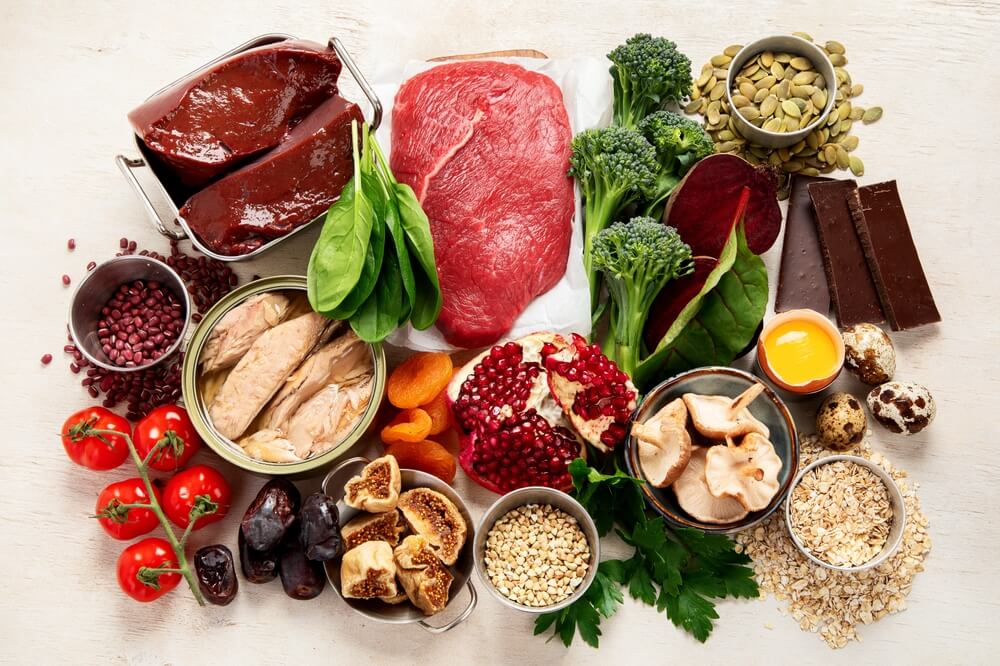
Which foods are rich in iron?
Natural sources of iron include:
| Animal-based foods | Plant-based foods |
|---|---|
| Black pudding | Wheat bran |
| Pork and veal liver | Millet flakes |
| Beef ham | Oat flakes |
| Beef, veal and pork | Green spelt |
| Other meat and sausage products | Whole grain rice |
| Egg yolk | Rye bread and other cereal products |
| Fish and seafood such as scallops, oysters, prawns or cooked tuna | Nuts, kernels and seeds (e.g. pumpkin and pine nuts or sesame seeds) |
| Hazelnuts, walnuts, peanuts and almonds | |
| Pulses, particularly beans and lentils | |
| Tofu | |
| Vegetables such as salsify, spinach, green peas, soya beans, leeks, asparagus, cauliflower and green leafy salads |
Good to know: Foods rich in vitamin C help the body absorb iron. Drinking a vitamin C-rich drink, such as a glass of orange juice, before eating iron-rich foods helps the body absorb iron.
Can iron deficiency lead to anaemia?
Yes, iron deficiency can lead to anaemia. Anaemia can have various causes. The most common form is iron-deficiency anaemia. This is a disorder of the blood-forming system. An iron deficiency leads to a reduced concentration of haemoglobin.
Possible symptoms of iron-deficiency anaemia include:
- pale skin and mucous membranes
- dry skin
- cracked corners of the mouth
- hair loss
- brittle nails
- chronic fatigue
- physical weakness
- Headaches
- Dizziness
- Tinnitus
- Shortness of breath
- Difficulty concentrating
- Food cravings
This list is not exhaustive. Furthermore, individual symptoms may be harmless or may indicate other medical conditions. Not everyone with iron-deficiency anaemia develops all the symptoms listed. If you suspect you have an iron deficiency or anaemia, you should always seek medical advice.
What are the symptoms of iron deficiency?
The exact symptoms of iron deficiency can vary greatly from person to person and sometimes depend on the severity of the deficiency. The more severe the deficiency, the more severe the symptoms.
Three stages of iron deficiency are distinguished:
- Stage 1: Iron stores are reduced, but sufficient red blood cells are still being produced. The deficiency is often still asymptomatic at this stage.
- Stage 2: Cells are no longer receiving an adequate supply of iron. Iron can no longer be mobilised from the stores quickly enough. Even the iron stored in the form of ferritin is now being broken down. At this stage, distinct symptoms such as tiredness, headaches or hair loss usually occur.
- Stage 3: Haemoglobin levels are significantly below normal, leading to severe iron-deficiency anaemia with associated symptoms.
The rule is: the earlier an iron deficiency is detected, the easier it is to treat. If symptoms persist, it is important to seek medical advice.
How is iron deficiency diagnosed?
Iron deficiency can be detected through a blood test. If iron deficiency is suspected, the doctor will usually arrange for a complete blood count.
Key laboratory parameters include, amongst others:
- Haemoglobin (Hb level): Indicates the concentration of haemoglobin in the blood
- Serum ferritin (iron stores): Indicates how well the body’s iron stores are replenished
- Transferrin saturation (transport iron): Indicates how much iron is being transported in the blood
If the suspicion is confirmed, it is important to identify the cause of the iron deficiency. Further investigations may be necessary for this.
How is iron deficiency treated?
Treatment depends on the cause and severity of the iron deficiency. Possible treatment options include:
- Dietary changes: Increasing the intake of iron-rich foods and those that promote iron absorption. Foods that inhibit iron absorption are avoided. Such a change in diet should be undertaken under medical supervision
- Treatment of possible sources of bleeding: If the iron deficiency is caused by blood loss, such as heavy periods or chronic bleeding, it is important to treat this underlying cause specifically.
- Iron replacement using iron tablets or coated tablets.
- Intravenous iron administration: In certain cases, iron can also be administered via an infusion. This is advisable, for example, if:
- oral iron supplementation is not sufficiently effective
- there is impaired iron absorption
- chronic inflammatory bowel diseases are present
- there are tumours
Important: Iron supplements should not be taken without consulting a doctor or under medical supervision. Iron deficiency can usually be treated effectively and without complications if it is detected early and managed by a healthcare professional.





