Summary
Flu vaccination, influenza vaccination
Definition: Inactivated or live vaccine against the strains of influenza virus currently in circulation
Dosage: one to two injections (the latter only for the first vaccination of children up to the age of 9)
Recommended for: everyone aged six months and over; particularly recommended for high-risk groups: those aged over 50, people with chronic underlying conditions, healthcare workers, and people with frequent social contact
Contraindications: Hypersensitivity to chicken egg protein and other components of the vaccine, as well as severe acute infections and a temperature above 38.5 degrees Celsius; the live vaccine must not be administered to children with immunodeficiency, severe asthma or those undergoing salicylate therapy
Cost:
A co-payment of 7 euros; the vaccination is free for children and young people up to their 18th birthday and for those exempt from prescription charges
What is influenza (the flu)?
Influenza, commonly known as the flu, is an often underestimated, highly contagious viral illness that is typically accompanied by a severe feeling of being unwell, a high fever, muscle and joint aches, a sore throat and a cough. In addition, a severe runny nose, diarrhoea, nausea and vomiting may occur. In some cases, influenza can take a severe and even life-threatening course, accompanied by serious complications such as pneumonia or myocarditis (inflammation of the heart muscle).
There are various types of influenza viruses. Experts refer to type A, type B, type C and type D influenza viruses, with humans primarily at risk from type A and subtypes of type A and type B.
Important: Influenza should not be confused with a common cold or a cold-like illness. The symptoms of influenza are significantly more severe than those of a common cold.
How is the flu transmitted?
Influenza viruses are usually transmitted via droplet infection – through talking, sneezing or coughing – and indirectly via contaminated hands and surfaces. However, influenza viruses can also be transmitted through what is known as contact transmission, for example by touching objects such as door handles.
What is the flu situation in Austria?
As in other countries, influenza is widespread in Austria, and there is a flu outbreak almost every autumn and winter. Every year, between five and fifteen per cent of the Austrian population become infected, and many actually fall ill with the real flu. Year after year, around 1,000 people in Austria die as a result of influenza, with children also being affected in isolated cases.
To find out about the current flu situation in Austria, the Austrian Agency for Health and Food Safety (AGES) provides weekly updated figures on estimated cases of influenza and influenza-like illnesses: https://www.ages.at/mensch/krankheit/krankheitserreger-von-a-bis-z/grippe.
What is the flu vaccination?
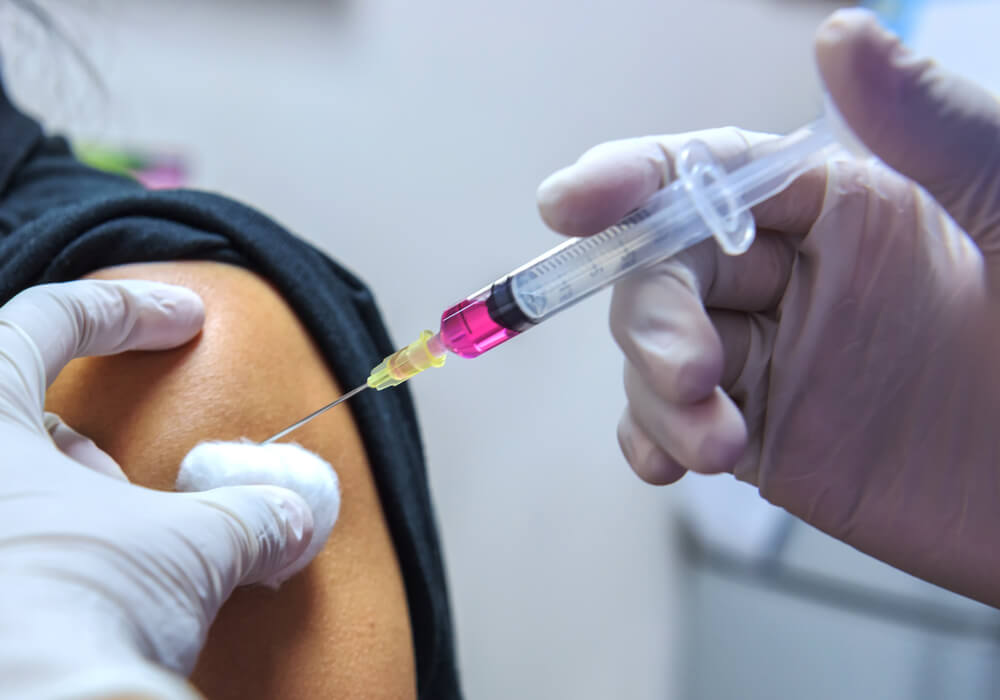
The influenza vaccination protects against infection with certain influenza viruses, of which there are numerous variants. As the composition of these viral variants changes constantly, the flu vaccination must be adapted annually.
The vaccine is usually an inactivated vaccine containing components of the virus variants that experts anticipate for the respective season. For people aged 60 and over, a high-dose vaccine is available, which contains a higher amount of antigen for increased effectiveness. For those aged 65 and over, a vaccine with adjuvants is also available. For children, there is also a live vaccine, which is available as a nasal spray.
The vaccine stimulates the immune system to produce antibodies against the viruses. This means that, upon contact with the actual influenza viruses, the body is protected and can fight off the flu. Full protection develops ten to 14 days after vaccination.
Who should be vaccinated?
Experts recommend the flu vaccination for everyone aged six months and over, but particularly for the following groups:
- People aged 60 and over
- People with certain chronic conditions
- People who are severely overweight
- People with a weakened immune system
- Pregnant women, breastfeeding women and women planning to have children
- Infants from the age of 6 months and toddlers
- Healthcare and care staff
- People with extensive social contact at work and in their leisure time (e.g. staff in the tourism sector)
When is the right time to get vaccinated?
The timing of the vaccination is crucial for effective protection against flu. In Austria, the flu season usually peaks after the turn of the year. As full protection from the vaccine only takes effect ten to 14 days after vaccination, experts recommend getting the flu jab ideally between October and mid-December. If you miss this window, it is still advisable to get vaccinated even during the flu season.
Can you still catch the flu despite being vaccinated?
Like all vaccinations, the flu jab does not offer 100 per cent protection. It is therefore possible, in rare cases, to contract influenza even after being vaccinated. This is particularly likely if infection occurs shortly before or during the period when immunity has not yet fully developed (within ten to 14 days of vaccination).
When should you not be vaccinated?
You should not be vaccinated if any of the following apply:
- A fever above 38.5 degrees Celsius
- An acute, severe infection
- Severe allergy to chicken egg protein or any other component of the vaccine
- In children and adolescents, immunodeficiency, severe asthma and treatment with salicylates are considered contraindications for the live vaccine (nasal spray).
What vaccine reactions and side effects can be expected?
As with any vaccination, temporary reactions may occur after a flu jab, lasting one to two days. Mild pain and swelling at the injection site are common and represent a normal reaction by the body to the vaccine. These indicate that the body is responding to the vaccine and beginning to build up protection.
Sometimes, cold-like symptoms may occur, including fever, headache, muscle and joint aches, and chills or sweating. These side effects usually subside after one to two days.
If the live vaccine, which is administered as a nasal spray, is used, a blocked or runny nose may also occur. These symptoms are also temporary and harmless.
Can you have the flu jab during pregnancy and whilst breastfeeding?
The flu vaccination is strongly recommended for pregnant women from the second trimester onwards. The vaccine is an inactivated vaccine and therefore does not cause an infection. There are also no contraindications to having a flu jab whilst breastfeeding. Furthermore, this can indirectly protect the baby from infection via the mother.
There are no contraindications to having a flu jab whilst breastfeeding either. The jab is safe during breastfeeding and enables the mother to indirectly protect her newborn from infection, as antibodies can be passed on via breast milk.
How much does the vaccination cost?
In Austria, a new Public Vaccination Programme (ÖIP) has been in place since autumn 2023, under which the flu vaccination is offered to everyone for a co-payment of seven euros. The vaccination is completely free for children and young people up to the age of 18, people exempt from prescription charges, and those taking part in vaccination campaigns in workplaces and in care homes.
Where are flu vaccinations available?
Many general practitioners and paediatricians in private practice offer the flu vaccination. There are also vaccination campaigns in workplaces, care homes and, in some cases, at the health authorities of the federal states. In Vienna, vaccinations are also available at four health centres run by the Austrian Health Insurance Fund (ÖGK). For enquiries regarding the flu vaccination, the ÖGK has a flu vaccination helpline: +43 5 0766-501510
FAQ
The Austrian Immunisation Schedule generally recommends vaccination for everyone aged six months and over. There is a specific recommendation for at-risk groups. These include, amongst others, people over the age of 50, those with chronic conditions, and healthcare workers.
Yes, the vaccinations can be administered at the same time. Both vaccinations are generally very well tolerated and there are no safety concerns regarding their simultaneous administration.
Influenza virus strains are constantly changing, and the vaccines have to be adapted anew every year. Adequate protection is therefore only guaranteed by having an annual flu jab.
Moderate physical activity is possible after having the flu jab. However, you should avoid strenuous exercise, as this can interfere with the production of antibodies.


Gesenhues S and A: A Practical Guide to General Practice. 9th edition, Urban & Fischer 2020.
Federal Ministry of Social Affairs, Health, Care and Consumer Protection: Austrian Immunisation Schedule 2023 (Version 1.1 of 23 December 2022)
https://www.sozialministerium.at/Themen/Gesundheit/Impfen/Impfplan-Österreich.html, accessed February 2024
https://www.gesundheit.gv.at/leben/gesundheitsvorsorge/impfungen/ueberblick/grippe, accessed February 2024
https://www.gesundheitskasse.at/cdscontent/?contentid=10007.887855&portal=oegkportal, accessed February 2024
https://www.rki.de/DE/Content/Infekt/Impfen/Materialien/Faktenblaetter/Influenza.pdf?__blob=publicationFile, accessed February 2024
https://impfen.gv.at/impfungen/influenza, accessed February 2024
https://www.impfen-info.de/grippeimpfung/fragen-und-antworten/, accessed February 2024